The roof was finished. The deck was safe again. The plumbing finally worked without knocking behind the kitchen wall. When I sent my father the last round of photos, he called me back and said, “Now it’s ready for summer.”
Two days later, I learned what he had actually been getting it ready for.
The cabin had never felt like property to me.
It had a deed, of course. Property taxes came due every year. My parents carried insurance on it. Legally, there had never been any confusion. Gary and Elaine Porter owned the place.
Emotionally, though, none of us called it their cabin.
It was always ours.
Our cabin. Our dock. Our summer place.
My parents bought it when I was sixteen and my younger brother, Nate, was twelve. Back then, it was hardly impressive. It had two bedrooms, a screened porch with old aluminum frames, a narrow dock, and a kitchen so small that two people trying to make breakfast together usually ended up arguing over who was blocking which cabinet.
The first summer, Dad spent three weekends repairing steps that had begun to sag.
Mom spent most of those same weekends complaining about mice.
Nate and I loved the place anyway.
I learned to fish there. Nate learned how to back a trailer there, after several attempts that involved Dad standing beside the driveway giving increasingly frantic hand signals.
Years later, I brought Tom there while we were dating.
After we married, the cabin became part of our children’s lives too.
Lily learned to swim off that dock. Connor caught his first fish there and told anyone willing to listen about it for the next six months, growing the fish by several inches with every retelling.
We had birthdays there, rainy afternoons playing cards, burned marshmallows, mosquito bites, forgotten sunscreen, wet towels draped over furniture despite Mom’s repeated objections, and long summer dinners that stretched until the light disappeared from the lake.
Those were ordinary things.
Eventually ordinary things become history.
And history can make a building stop feeling like real estate.
That was where I made my first mistake.
I knew the legal truth without ever emotionally accepting what it meant.
The cabin belonged to my parents.
Not to me.
Not to Nate.
Not to our children.
By the time I was forty-three, I had also become the person who handled most of the practical problems involving the property.
I worked as a procurement manager for a packaging manufacturer. My job involved bids, vendors, contracts, schedules, cost comparisons and the kind of conversations where you asked why something that cost twelve thousand dollars last year suddenly cost fifteen.
So whenever the cabin needed anything complicated, Dad usually called me.
A water heater needed replacing? I found three estimates.
Storm damage near the dock? I knew who to call.
A dead tree leaning toward the driveway? I arranged the removal.
Nate helped differently.
He lived farther away and used the cabin less. When he came, he might cut brush, move something heavy with Dad or spend an afternoon repairing something small. Then he would go home.
For years I quietly treated that difference as evidence that I cared more.
I did not say it directly very often, but I thought it.
I was the organizer.
I was the one who answered calls.
I was the one comparing quotes.
Therefore, in my mind, I was the one protecting the place.
That belief made what happened next easier than it should have been.
Dad called me in late March.
I was at my desk at work when his name appeared on my phone.
“Cabin took a beating over winter,” he said.
“How bad?”
“Roof’s rough. Deck needs work. There’s a plumbing issue too.”
I opened a blank document automatically.
“How much are we talking?”
“Don’t know yet.”
Then he said something I would replay many times later.
“I don’t know how much longer we can keep doing this.”
I heard one meaning.
He meant something else.
At the time, I assumed he was talking about the cost of maintaining an aging property. My parents were getting older. The cabin required more work almost every year. Repairs that once meant a few hundred dollars were now becoming thousands.
The possibility of losing the place bothered me more than I expected.
“What if we spread the repairs out?” I asked. “The roof probably can’t wait. The deck depends on what they find. Plumbing maybe we can patch.”
From somewhere behind him, Mom called, “It is not getting patched again.”
Dad lowered his voice.
“I just want the grandkids to get another good summer up there.”
That was the sentence that got me.
Not the roof.
Not the plumbing.
The grandkids.
A few days later, the estimates started coming in.
The roof would be the largest expense. The deck needed structural repairs and a section of new railing. Plumbing work was necessary around the kitchen and utility area.
Then came the smaller items that always appeared after contractors began looking closely: damaged exterior trim, a bad step, cleanup, minor wood replacement.
The total was moving toward $28,000.
Dad asked whether Nate and I could help.
Nate called me that evening.
“How much are you putting in?”
“I don’t know yet.”
“I’m not doing five figures.”
His answer annoyed me immediately.
“You haven’t even seen all the quotes.”
“I don’t need to.”
“So you’re just not helping?”
“That’s not what I said. I’ll help with smaller stuff.”
I leaned back in my chair.
“Mom and Dad have paid for that place for almost thirty years.”
“I know.”
“We’ve all used it.”
“I know that too.”
“So?”
“So I’m not putting twenty or thirty thousand dollars into property I don’t own.”
I remember thinking he sounded selfish.
“Wow.”
“What?”
“Nothing.”
“No. Say it.”
“I just think it’s interesting how much you like the cabin when somebody else is paying for it.”
There was a short silence.
Then Nate said, “Megan, liking something doesn’t make me an owner.”
I did not appreciate that sentence until much later.
Tom raised almost the same concern.
One evening we sat at our kitchen table with the estimates spread between us and our savings account open on the laptop.
We had money set aside for replacing several windows at home. College expenses were approaching faster than I wanted to admit. We had an emergency fund that neither of us considered available for anything other than a real emergency.
Twenty-eight thousand dollars was possible.
Possible was not the same as painless.
Tom tapped the estimate with one finger.
“This is a lot of money for a property we don’t own.”
“I know.”
“Should we put something in writing?”
I stared at him.
“With my parents?”
“I’m not suggesting a fifty-page contract.”
“It’s a family cabin.”
He held my gaze.
“It’s their cabin.”
That irritated me more than it should have.
“They’re not selling it.”
“How do you know?”
“Because that’s why we’re fixing it.”
Tom did not respond immediately.
Then he asked, “Did they actually say that?”
I thought about Dad saying they could not keep doing this.
I thought about his comment about the grandkids having another summer.
I thought about Mom discussing new porch cushions a week earlier.
“It’s obvious.”
Tom nodded once.
“Then ask.”
I should have.
Instead, I told myself asking would insult my parents.
It would turn family into a transaction.
These were the people who had raised me. This was the cabin where my children had spent nearly every summer they could remember.
I was not buying equity.
I was preserving something that belonged to our family in every way that seemed important.
The next morning I called Dad.
“I’ll cover the repairs.”
There was a pause.
“All of them?”
“Up to twenty-eight. If it goes higher, we talk again.”
He let out a breath.
“That’s generous.”
“I want us to keep the place.”
Another pause.
Then he said, “I know.”
He never said, “We are keeping it.”
I heard the sentence anyway.
That was my second mistake.
The first had been treating the phrase our cabin as though it gave me a stake.
The second was treating silence as agreement.
Once I committed to paying, the repairs became a project, and projects were something I knew how to manage.
I obtained three roofing quotes and two deck estimates. I worked with a plumber Dad had used before and got a second price through a supplier contact.
Dad and Mom still approved the work because they owned the property, but I handled most of the scheduling, questions, invoices and follow-up.
The roof came in just under $15,000.
The deck was a little over $6,000.
Plumbing was roughly $3,500.
Then came the smaller expenses.
By the time everything was finished, I had spent almost exactly $28,000.
The money did not come from retirement savings or some account so large that losing twenty-eight thousand dollars would be a minor inconvenience.
Tom and I had built those savings over years.
We had discussed using part of it for our own house. We knew Lily’s college costs were getting closer. We could absorb the expense, but doing so required choices.
Tom never tried to stop me.
But each time another invoice arrived, I knew what he was thinking.
One night while I paid the deck contractor, he finally asked again.
“You sure this is what you want?”
“Yes.”
“I’m not asking whether you love the place.”
“I know.”
“I’m asking whether you’re sure your parents plan to keep it.”
I closed the laptop.
“Dad literally said he wants the grandkids to have another summer there.”
Tom leaned back in his chair.
“That’s not the same sentence.”
I stared at him.
“Tom.”
“I’m not trying to make you paranoid.”
“It sounds like you are.”
“Fine. I’ll stop.”
He did.
That should have made me feel better.
It did not.
The next morning, Mom sent me a photo of the screened porch.
Maybe we finally replace those cushions this summer.
I replied that I would agree only if she promised not to buy floral ones again.
She sent three laughing emojis.
Whatever doubt I still had disappeared.
Why would she talk about porch cushions if they were planning to sell?
Why would Dad ask whether Lily wanted the small bedroom or loft space?
Why was he pushing the roof crew to finish before June?
Every conversation seemed to point toward another summer.
At least, every conversation sounded that way to me.
The work took a little over a month.
I drove to the cabin twice while the contractors were there.
On the first trip, old roofing material was stacked near the driveway and part of the deck railing had been removed. The place looked wounded.
The second time, it looked like itself again.
Better, actually.
The new roof sharpened the entire exterior. The repaired deck no longer shifted beneath your feet. The plumbing had finally stopped making the knocking sound Dad had complained about for years.
I stood there and felt proud.
Not because I thought I had made an investment.
The word never crossed my mind.
I thought I had purchased time.
More summers.
More family dinners.
Another season of Connor trying to catch the same enormous fish he insisted lived under the dock.
Another year before the cabin became one of those places we discussed in the past tense.
Nate called while I was there.
“How bad did the total get?”
“Twenty-eight.”
A pause.
“Twenty-eight thousand?”
“Yes.”
“Megan.”
“What?”
“That’s a lot.”
“I’m aware.”
“You could have replaced half the windows in your house.”
“Thank you, Tom.”
“What?”
“Nothing.”
Nate sighed.
“I’m not criticizing you.”
“It sounds like you are.”
“I just hope you know what you’re doing.”
That irritated me.
“Somebody had to care enough to keep the place going.”
The moment I said it, I knew it was unfair.
Nate went quiet.
Then he said, “I care about the cabin.”
“Then why did I pay for all this?”
“Because you decided to.”
I hated how simple he made it sound.
“You said you’d help with smaller things.”
“I did.”
“You also told me why you wouldn’t put that much money in.”
“Because I don’t own it.”
“Yes.”
There was no satisfaction in his voice.
No I told you so.
Just certainty.
I ended the call frustrated with him and, if I was being truthful, slightly frustrated with myself.
Then Dad called.
“How’s it look?”
“Good. Deck is solid. Roof’s done. Plumbing too.”
I sent him photos.
A few minutes later, he called back.
“Looks great.”
I smiled.
“Twenty-eight thousand dollars of great.”
He laughed.
Then he said, “Now it’s ready for summer.”
That sentence settled everything in my mind.
I pictured all of us there in July.
Dad at the grill.
Mom complaining about mosquitoes.
Lily on the dock.
Connor asking permission to sleep on the porch.
I drove home believing the money had been worth it.
Two days later, I returned to drop off fresh linens and retrieve a contractor key left inside.
I had been there less than twenty minutes when a car pulled into the driveway.
Then another.
A woman stepped out carrying a folder.
A man followed.
I assumed they were connected to one of the contractors.
The man walked onto the repaired deck, looked around, then noticed several family boxes near the doorway.
“When will your things be out?” he asked.
I frowned.
“Sorry?”
He gave me a polite smile.
“We close Friday.”
For a second, my brain refused the sentence.
“This cabin isn’t for sale.”
The woman with the folder stopped walking.
The man looked toward her.
Then back at me.
“I’m sorry?”
“You said you’re closing Friday.”
“Yes.”
“On what?”
He gestured toward the cabin.
“This property.”
I laughed once.
Not because anything was funny.
It was the sound a person makes when reality arrives in a form so wrong that the mind tries rejecting it.
“No. My parents own this place.”
The woman stepped forward.
“I’m Melissa Grant. I’m representing David.”
The man offered his name.
“David Keller.”
I barely heard him.
Melissa’s expression had become careful and professional.
“Are you Gary and Elaine Porter’s daughter?”
“Yes.”
She nodded slowly.
“I see.”
That was the moment my stomach dropped.
She had known my parents’ names before I gave them to her.
I looked at David.
“You’re buying this cabin?”
His confidence disappeared.
“Yes.”
“When?”
“Friday.”
“How long has that been scheduled?”
He glanced toward Melissa.
She answered.
“The closing date has been set for a little while.”
“A little while?”
I looked around the room.
Fresh plumbing.
Repaired deck.
New roof.
Clean linens in my arms.
Everything suddenly looked different.
Nothing had physically changed.
Its meaning had.
David shifted his weight.
“I’m really sorry. I assumed everyone knew.”
I believed him.
David had not asked me for $28,000.
Melissa had not called me about the roof.
Neither one had spent a month discussing summer plans with me.
“Is this a final walkthrough?” I asked.
Melissa nodded.
“Pre-closing walkthrough.”
That made it worse.
This was not a possible sale.
They were at the finish line.
David glanced toward the boxes.
“That’s why I asked about the personal things.”
“I understand.”
I needed to leave before I said something that had nothing to do with him.
I gathered the linens.
A framed photograph of Lily and Connor remained on a shelf, so I took that too.
Only clearly personal items.
For half a second, anger produced an ugly thought.
Take something back.
The railing.
Fixtures.
Anything.
I had paid for them.
But there was no reasonable world in which I could tear shingles off a roof because my parents had misled me.
David had done nothing wrong.
And the cabin was not mine.
That truth hurt more now than when Nate had said it.
I carried everything to my car and sat behind the steering wheel without starting the engine.
Then I called Dad.
He answered on the fourth ring.
“Megan?”
“How long ago did you accept the offer?”
Silence.
Not confusion.
Not denial.
Silence.
I shut my eyes.
“How long, Dad?”
“Where are you?”
“At the cabin.”
Another pause.
“You weren’t supposed to be there today.”
That answer revealed almost as much as anything else could have.
“The buyer is here.”
Dad exhaled.
“Megan.”
“How long ago?”
“About five weeks.”
I stared at the repaired deck through the windshield.
Five weeks.
Almost the entire repair process.
“You already had an accepted offer when I agreed to pay for the work.”
“It wasn’t that simple.”
“It sounds extremely simple.”
“There were contingencies.”
“What does that have to do with my question?”
“The deal could have fallen through.”
“But you accepted the offer.”
“Yes.”
One word.
There it was.
I had spent nearly $28,000 after my parents had already agreed to sell.
Then another question came to me.
“Did the buyer’s inspection happen before the repairs?”
Dad hesitated.
“Some of the work had already come up.”
“That isn’t what I asked.”
“The inspection identified things too.”
Heat moved into my face.
The urgency of everything changed meaning.
The roof.
The deck.
The plumbing.
I thought we had been racing the weather and summer.
At least part of the rush had been about delivering the property to a buyer.
“You used my money to get your sale ready.”
“That’s not fair.”
I nearly laughed again.
“Not fair?”
“You’ve used that cabin for almost thirty years. Your kids practically grew up there. Your mother and I paid the taxes, insurance, utilities and repairs year after year.”
Every statement was true.
None answered my question.
“You offered to help,” Dad continued.
“I offered because I thought you were keeping it.”
“We never promised that.”
I went quiet.
Technically, he was right.
There was no contract.
No promise of ownership.
No written guarantee that the cabin would remain in the family.
Dad seemed to interpret my silence as progress.
“It’s our property, Megan.”
“I know.”
That stopped him.
“I know it’s yours.”
“Then what are we arguing about?”
“Why you let me spend twenty-eight thousand dollars on it while you knew.”
He returned to the same defense.
The sale could have fallen through.
I asked him one question.
“If you had told me five weeks ago that you already had a buyer and expected to close this summer, do you think I still would have paid twenty-eight thousand dollars?”
Nothing.
Mom’s voice came faintly through the phone.
Apparently I was on speaker.
I waited.
“Dad?”
Finally he said, “That’s not the point.”
It was exactly the point.
Neither parent would answer because both knew the answer.
I called Nate before leaving.
Not because I wanted advice.
For one ugly minute, I wondered whether he had known.
He answered quickly.
“Hey.”
“Did you know Mom and Dad sold the cabin?”
Silence.
Then, “They what?”
That was enough.
“They close Friday.”
“You’re serious?”
“I’m sitting in the driveway. The buyer just finished a walkthrough.”
Nate swore softly.
“When did this happen?”
“They accepted the offer five weeks ago.”
Another pause.
“Megan, don’t.”
“I wasn’t going to say anything.”
“Yes, you were.”
“No. I was going to ask whether they accepted it before you paid for the repairs.”
“They did.”
He exhaled.
His voice changed.
Not triumph.
Concern.
“What did they tell you?”
“The same thing they told you. That they couldn’t keep spending money on the place.”
“That’s why I said no.”
“I know.”
“I thought they might sell eventually.”
I tightened my hand around the steering wheel.
“You could have said that.”
“Megan, I did.”
“No. You said you weren’t putting money into property you didn’t own.”
“Because I knew they could sell it.”
That sentence hurt.
Not because Nate was cruel.
Because I had dismissed the exact risk he understood.
“I thought you didn’t care enough.”
“I know.”
“You knew?”
“You weren’t exactly subtle.”
Despite everything, I almost laughed.
Then he said, “For what it’s worth, I’d be furious too.”
“That helps a little.”
“It probably shouldn’t.”
“No.”
He was quiet.
“You thought ‘family cabin’ meant we had some kind of stake in it?”
“I guess I did.”
“I never did.”
His answer was painfully clean.
He had understood the transaction more clearly than I had.
That did not make my parents honest.
But it forced me to admit something uncomfortable.
I had made a $28,000 decision based partly on an assumption I had never tested.
When I arrived home, Tom was in the garage.
He looked at my face and stopped what he was doing.
“What happened?”
“They sold it.”
He stared.
“What?”
“They sold the cabin. Closing Friday.”
He did not say I told you so.
That almost made me cry.
“When did they accept the offer?”
“Five weeks ago.”
His expression changed.
“Before the roof?”
“Yes.”
“Before the deck?”
“Yes.”
“Before most of the invoices?”
“Yes.”
He leaned against the workbench.
“And they let you keep paying.”
“Yes.”
He had every reason to be angry.
The money had come from our savings too.
Instead he asked, “What do you want to do?”
“I want the money back.”
“Okay.”
“And I want Dad to admit what he did.”
Tom nodded.
“That may be harder.”
“I know.”
Inside, I opened the laptop and collected every invoice into one folder.
Roof.
Deck.
Plumbing.
Exterior work.
Payments.
Twenty-seven thousand eight hundred and change.
Then I reviewed my text messages with Dad.
Most were ordinary contractor conversations.
Access.
Schedules.
Approval.
Nothing promised they would keep the property.
Nothing gave me ownership.
Then I found the softer language.
Want to get this handled so everyone can enjoy the place this summer.
Mom had discussed Lily taking the small room again.
Dad had written that once the repairs were finished, “we should finally be set for summer.”
And then there was his last message.
Now it’s ready for summer.
No single text was a contract.
Together, they described the future I had believed in.
Tom read over my shoulder.
“They knew what you thought.”
“Yes.”
“That’s different from you assuming something with no reason.”
Exactly.
I had been careless.
They had benefited from that carelessness.
The next morning I called a local civil attorney.
I was not eager to sue my parents.
I wanted someone without a family history to tell me whether the distinction I was making had any substance.
I explained the facts.
My parents owned the property.
Their adult daughter paid roughly $28,000 for repairs.
An accepted offer already existed before most of those payments.
I had not been told.
There was no written promise to keep the property.
The attorney did not give me a television answer.
She did not say it was an easy case.
She did not promise every dollar plus damages.
She said facts mattered.
Specific representations mattered.
What my parents knew mattered.
The benefit provided by the repairs could matter.
Any claim would depend on documentation, and litigation would cost money and time while damaging a relationship that was already strained.
“So you’re saying I might have an argument?”
“I’m saying you may have options. That’s not the same thing.”
“What would you do?”
She paused.
“I’d decide what result you actually want before deciding which process gets you there.”
That sounded annoyingly like something Tom would say.
I thanked her.
For about an hour, I considered filing something immediately.
Not because I wanted a courtroom.
I wanted a neutral person to tell Dad, You don’t get to do that.
Then Mom called.
I almost let it go to voicemail.
Instead I answered.
“Hi.”
Her voice was careful.
“Megan, I know you’re upset.”
“Please don’t start there.”
She went quiet.
“Did you know they’d accepted the offer before I agreed to pay?”
“Yes.”
No hesitation.
That almost hurt more.
“Did you know I thought the repairs were so we could keep using the cabin?”
A pause.
“I knew you wanted us to keep it.”
“That’s not what I asked.”
“I knew.”
I closed my eyes.
“Then why didn’t you tell me?”
“There were contingencies. We didn’t know for certain the sale would close.”
“That’s Dad’s answer.”
“It’s true.”
“So if the deal fell through, the cabin would be repaired.”
“Yes.”
“And if it didn’t?”
Silence.
I lowered my voice.
“If I had known there was already an accepted offer, would I have spent twenty-eight thousand dollars?”
“Megan—”
“Yes or no?”
The silence lasted several seconds.
Then Mom said, “Probably not.”
There it was.
The first completely honest answer.
Strangely, I felt calmer.
Not better.
Clearer.
“You knew the information would change my decision.”
“We thought the repairs were fair.”
“That wasn’t your decision to make.”
“You’ve used that cabin your entire life.”
“I know.”
“We paid for everything for years.”
“I know.”
“You were willing to help.”
“Because I believed I was helping preserve it.”
Mom began crying.
“I didn’t know how to tell you.”
“You say, ‘We accepted an offer.’”
“I knew you’d be hurt.”
“So instead you waited until a stranger told me.”
She had no answer.
The sale closed Friday.
I did nothing to interfere.
David had done nothing wrong. My parents owned the cabin. Whatever dispute existed inside my family, I was not going to turn an innocent buyer into leverage.
By Friday afternoon, the cabin belonged to someone else.
That night Dad texted me.
We want to make this right. We can give you $7,500 from the sale as a gesture.
I stared at the message.
Tom read it.
“What do you think?”
I typed several responses and deleted them.
Finally, I wrote:
I’m not asking for a gesture.
Dad answered:
Then what are you asking for?
I wrote:
For you to admit that you knew what I thought I was paying for.
He did not respond.
That was when I realized the argument was no longer primarily about $28,000.
It was about whether my parents believed they had the right to replace my choice with theirs because they considered their version of fairness more important.
Mom sent one more message after the closing.
It’s done.
Two words.
Twenty-seven years reduced to two words.
I did not answer.
That weekend, I kept remembering insignificant things.
Dad’s coffee mug.
The notch in the dock where Nate dropped his tackle box at thirteen.
The porch screen Tom and I repaired the first summer after we married.
None of those things had ever legally belonged to me.
That had never mattered until suddenly it mattered completely.
Yes, the money bothered me.
But what hurt more was realizing I had been saying goodbye without knowing it was goodbye.
My parents had taken even that choice from me.
Three days after closing, Nate called.
“Mom wants everybody to come over.”
“Why?”
“She and Dad are fighting.”
“That sounds like something they can handle themselves.”
“This is about us.”
I nearly refused.
Then Nate added, “Mom told him she wants to give you the full twenty-eight back.”
That got my attention.
“Dad doesn’t?”
“He thinks seventy-five hundred was generous.”
I laughed without humor.
“Of course he does.”
Tom came with me that Sunday. We agreed he would stay mostly out of the conversation unless someone pulled him into it.
Nate was already there.
Dad sat at one end of the dining table.
Mom sat at the other.
The distance looked deliberate.
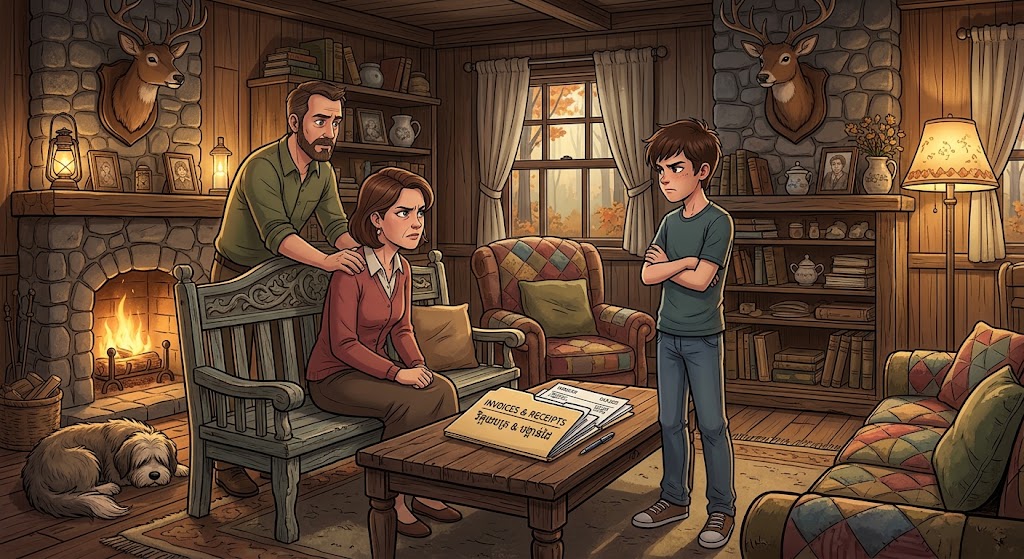
I placed a thin folder on the table.
Dad looked at it.
“What’s that?”
“Invoices.”
“I know what you spent.”
“Good. Then we don’t need to waste time proving the number.”
I sat down.
“I’m not here to argue about whether you had the right to sell the cabin.”
“We did.”
“I know.”
The answer visibly frustrated him.
He wanted that argument because it was the one he could win.
“You owned it,” I said. “You could sell it.”
“Exactly.”
“But you didn’t own my decision.”
He frowned.
“What does that even mean?”
“It means I got to decide whether I wanted to spend twenty-eight thousand dollars improving property that was already under contract.”
“You volunteered.”
“Without knowing that.”
“You knew it wasn’t yours.”
“Yes.”
“You knew we might sell someday.”
“Yes.”
“So what exactly did we hide?”
Mom looked at him.
“Gary, no.”
“I want her to answer.”
I did.
“You hid the fact that you’d already accepted an offer.”
“The sale wasn’t guaranteed.”
“You keep saying that because it’s true. It still doesn’t answer the question.”
Dad’s face tightened.
I had rehearsed only one thing.
Not a speech.
A question.
“If you had told me the day you asked for help that there was already an accepted offer and a buyer hoping to close in five weeks, would you have gotten twenty-eight thousand dollars from me?”
Dad looked away.
I waited.
He reached for his coffee.
“Dad.”
He set the cup down.
“I don’t know.”
Mom spoke immediately.
“Yes, you do.”
He turned toward her.
“Elaine.”
“You do.”
She looked at me.
“No. We would not have gotten the money.”
Dad shook his head.
“You can’t know that.”
Mom’s voice sharpened.
“She told me herself she was paying because she wanted another summer for the kids.”
I stared at her.
“You knew that?”
“Yes.”
“When?”
“Before the roof started.”
That hurt.
Dad responded quickly.
“That doesn’t change the fact that the repairs needed to be done.”
“It changes why I was paying for them.”
“The cabin needed a roof whether we kept it or sold it.”
“Then you should have paid for your roof.”
Dad struck one palm against the table.
“You benefited from that place for almost thirty years.”
There it was.
The argument underneath the argument.
I nodded.
“Okay.”
Everyone looked at me.
“You’re right.”
Dad appeared surprised.
“My family used the cabin for years. My children practically grew up there. You and Mom paid taxes, insurance, utilities and repairs. I benefited.”
Dad nodded.
“Exactly.”
“But that still doesn’t answer why you hid the sale.”
“I didn’t hide it.”
Nate finally spoke.
“You didn’t mention it.”
Dad turned toward him.
“That’s not the same thing.”
Nate shrugged.
“It is when you know the information changes the answer.”
Dad’s expression hardened.
“You stayed out of the repairs entirely.”
“Yes.”
“You barely contributed anything.”
“I told you exactly why.”
Dad said nothing.
Nate continued.
“I said no because I knew I didn’t own the place.”
Then he looked at me.
“Megan said yes because she believed you were keeping it.”
Hearing him say it changed something in me.
I had judged Nate for weeks.
He had not cared less.
He had simply understood the arrangement more accurately.
“I owe you an apology,” I told him.
Nate blinked.
“For what?”
“I acted like your boundary meant you didn’t care about the cabin.”
He nodded once.
“You were pretty annoying about it.”
“Thank you.”
“You’re welcome.”
Even Mom almost smiled.
Dad did not.
“So now I’m the only villain.”
“No,” I said. “I made a mistake too.”
That surprised him.
“I spent twenty-eight thousand dollars without asking the most obvious question. I heard ‘family cabin’ and treated it like I had some permanent stake in it. I didn’t. Tom told me to ask about your long-term plan. I didn’t.”
Dad leaned forward.
“Then why is this all on us?”
“Because my failure to ask doesn’t make your decision to withhold the answer honest.”
He stopped.
“You knew what I thought. Mom just admitted it.”
Mom looked down.
“You knew I believed I was paying to keep the cabin in the family. Instead of correcting me, you talked about summer. You talked about the grandkids. You pushed to get everything done before June.”
“I did want them to have another summer.”
“But you knew there probably wasn’t going to be one.”
For the first time, Dad looked less angry than tired.
Finally he said, “I thought it was fair.”
“What was fair?”
“You putting something back into the place.”
No one interrupted him.
“Your mother and I paid for everything for years. You used the cabin more than Nate. Your kids used it constantly. You’re doing well. You could afford to help.”
I nodded.
“That’s what you should have said.”
Dad looked at me.
“You might have helped anyway.”
“Maybe.”
“How much?”
“I don’t know. Five thousand. Ten. Maybe I would have paid for one project as a thank-you for all those years.”
His jaw tightened.
“But not twenty-eight.”
“No.”
There it was.
The answer he had avoided from the beginning.
“Did you think I might say no if you told me there was already a buyer?”
Dad stared down at the table.
Mom answered.
“Yes.”
He looked sharply toward her.
Then slowly back at me.
Finally he said, “Yes.”
Nobody moved.
It was not a confession to some elaborate scheme.
He did not claim he had planned every sentence for months.
In a way, what he admitted was more revealing.
He believed my informed decision might be unfair.
So he had decided I did not need all the information.
He had replaced my judgment with his.
“That’s the part I can’t get past,” I said.
Dad looked tired.
“I thought you owed something to the place.”
“Then you should have asked me to give it.”
He had no answer.
Mom slid a bank statement envelope across the table.
“I want to pay her back.”
Dad frowned.
“All of it?”
“All of it.”
“You’re acting like she got nothing from that cabin.”
Mom looked at him.
“Past memories are not a payment agreement.”
“Twenty-eight thousand comes out of our retirement money.”
“No,” Mom said. “It comes out of the cabin sale.”
“It’s still our money.”
“And it was her money when she paid the contractors.”
Dad stopped talking.
Mom turned toward me.
“I knew why you were doing it.”
Her eyes filled.
“I kept telling myself the deal might fall apart. If it did, at least the cabin would be fixed.”
She wiped beneath one eye.
“But I also knew if we told you, you probably wouldn’t pay.”
I said nothing.
“I should have told you.”
That apology mattered more than the envelope.
Dad took longer.
He stared at the invoice folder.
“I still think we were entitled to ask you to contribute.”
“You were.”
He looked up.
“You were entitled to ask.”
I paused.
“You weren’t entitled to arrange my answer.”
Something in his expression finally changed.
A week later, $28,000 appeared back in our account.
The full amount.
I expected relief.
Instead I stared at the balance and felt almost nothing.
Tom came up behind me.
“It’s back.”
“Yeah.”
“You okay?”
“I thought this would fix more.”
He pulled out the chair beside me.
“It fixed the money.”
That was exactly it.
The transaction had been corrected.
The relationship had not.
For several months I kept some distance from my parents.
I did not cut them off.
I still called Mom.
We still visited.
But I stopped treating family trust as a substitute for clarity.
No large informal loans.
No major expenses on property I did not own without understanding the ownership and future plans.
I stopped discussing our savings with Dad.
Not because I suddenly believed every relative was trying to use us.
Because boundaries work better when they exist before resentment becomes necessary.
Dad apologized eventually.
Not beautifully.
Not all at once.
His first attempts included too many explanations.
Then one afternoon he said something different.
“I thought I knew what was fair better than you did.”
I waited.
He looked at me.
“I was wrong.”
That was the first apology that sounded like he understood.
I accepted it.
Trust returned more slowly.
The following summer, we did not buy another cabin.
I had no interest in replacing one sentimental property with a more expensive one just to prove we could.
Instead, Tom rented a small cottage near a state park for four days.
Nothing fancy.
No private dock.
No history.
Nate’s family joined us for two nights.
Connor complained that the fishing had been better at Grandpa’s cabin.
Lily told him every fish he had ever caught was apparently the greatest fish in Wisconsin.
One evening, after everyone else went inside, Lily and I stayed outside.
She asked, “Do you miss the cabin?”
I thought about the porch.
The dock.
Dad grilling in the rain.
Mom complaining about wet towels.
Twenty-seven years of ordinary things that had become precious because they had ended.
“Yeah,” I said. “A lot.”
Then another thought came.
“I think I miss what I thought it meant more.”
Lily looked at me.
“What did you think it meant?”
“That because all of us loved it, somehow it belonged to all of us.”
“But it didn’t?”
“Not the building.”
She thought about that for a moment.
Then she pointed toward the rental cottage.
“This doesn’t belong to us either.”
I smiled.
“No.”
She looked back toward the rest of the family inside.
“But we’re still here.”
“Yes,” I said. “We are.”
That was enough.
My parents had always owned the cabin.
I eventually learned the difference between owning a place and owning the memories attached to it.
They were allowed to sell one.
What they were never entitled to take was my right to decide what I was willing to give up for it.
I should have asked more questions.
They should have told me the truth before I spent a dollar.