- PART 3
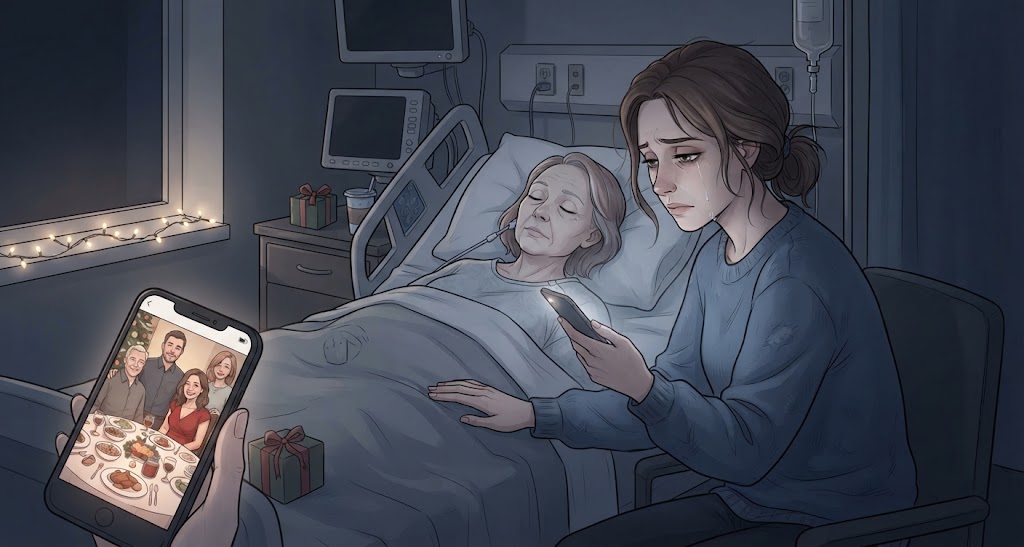
- I opened my phone again. His photograph was still there.
- Everyone smiling. Everyone eating. Everyone together.
- And beneath it: Wish you were here. I typed three different responses.
- I wish you were here too.
- Deleted.
- My mom almost died tonight.
- Deleted.
- How could you do this?
- Deleted.
- Finally, I wrote nothing.
- I turned the phone off.
- That was the first time I stopped explaining my pain to Grant.
- I didn’t know it then, but it was also the beginning of the end of the woman I had become for him.
- My mother survived Christmas.
- Barely.
- Her blood pressure stabilized around three in the morning, but the doctors discovered another complication that required additional treatment.
- The hospital stay that was supposed to last two weeks stretched into three.
- Then four.
- Then six.
- January came.
- Then February.
- Then March.
- Ninety days.
- Ninety days of hospital corridors, plastic chairs, vending-machine coffee, medical charts, and whispered conversations outside operating rooms.
- Ninety days of watching my mother fight for every ordinary thing most people took for granted.
- The first time she managed to stand without assistance, she cried.
- I cried with her.
- The first time she ate half a bowl of soup, I took a photograph.
- The first time she walked ten steps down the hallway, I clapped like she had won a marathon.
- Grant was never there.
- Not once.
- He occasionally asked questions.
- “How is she?”
- “Did the doctor say anything?”
- “Is she getting better?”
- But he never came to see her.
- Not even once.
- I eventually stopped asking.
- Our marriage changed quietly.
- There was no dramatic explosion.
- No screaming match.
- No broken dishes.
- Instead, something inside me simply became still.
- I stopped waiting for him to become the husband I needed.
- I stopped checking the hospital entrance whenever the elevator doors opened.
- I stopped telling my mother that Grant was coming.
- And I stopped making excuses for him.
- My mother noticed.
- She always noticed.
- One afternoon, after physical therapy, she looked at me and said, “Rachel.”
- “Yes?”
- “Are you happy?”
- The question caught me off guard.
- I laughed nervously.
- “Mom, you’re in the hospital. Why are you asking me that?”
- “Because you’re avoiding the answer.”
- I looked down at my hands.
- “I’m fine.”
- “That wasn’t my question.”
- I said nothing.
- She reached for my hand.
- “Don’t stay somewhere just because you remember how it felt when it was good.”
- My throat tightened.
- “Mom…”
- “I know you love him.”
- I stared at her.
- “But love isn’t supposed to require you to disappear.”
- Those words followed me for months.
- My mother finally came home in late March.
- She was weak.
- She needed help bathing.
- She couldn’t climb stairs alone.
- She needed medication at specific times.
- So I moved into her house temporarily.
- Grant complained.
- “You’ve been gone for three months.”
- “My mother nearly died.”
- “I know that.”
- “Then why are you saying it like I went on vacation?”
- He rubbed his forehead.
- “Rachel, I’m your husband.”
- “And she’s my mother.”
- “So where does that leave me?”
- I looked at him.
- “I don’t know anymore.”
- He became quiet.
- That should have frightened me.
- Instead, it relieved me.
- For the first time, I wasn’t afraid of his disappointment.
- I wasn’t trying to fix his mood.
- I wasn’t apologizing.
- I was simply tired.
- After a few seconds, Grant said, “When is she expected to be independent again?”
- I almost laughed.
- Instead, I said, “I don’t know.”
- He walked away.
- That night, I slept in my mother’s guest room.
- I didn’t miss our bed.
- That frightened me more than anything.
- The months that followed were slow.
- My mother recovered gradually.
- I returned to work part-time.
- Grant and I remained married, but our relationship became something neither of us knew how to name.
- We lived in the same condo but moved around each other like strangers.
- Sometimes he tried to act normal.
- He would ask what we should have for dinner.
- He would send me funny videos.
- He would talk about work.
- I answered politely.
- But the old version of me was gone.
- One evening in June, he came home carrying a small paper bag.
- “I got you something.”
- I looked inside.
- A necklace.
- It was beautiful.
- For a moment, I felt something old stir inside me.
- Then I remembered the hospital.
- The empty chair beside me.
- My mother’s hand trembling in mine.
- Grant’s photograph from Christmas.
- I closed the bag.
- “Thank you.”
- He frowned.
- “You don’t like it?”
- “I do.”
- “You don’t sound like you do.”
- “I don’t know what you want me to say.”
- He sat across from me.
- “I want my wife back.”
- I looked at him.
- “She never left.”
- “You’ve changed.”
- “Yes.”
- “Because of my mother?”
- I almost smiled.
- “No.”
- “Then what?”
- “Because I finally understood something.”
- “What?”
- “That being needed isn’t the same as being loved.”
- He stared at me.
- I thought he might argue.
- Instead, he stood and walked into the bedroom.
- Neither of us mentioned the conversation again.
- Summer passed.
- Then fall.
- My mother’s strength returned.
- She began gardening again.
- She started complaining about my cooking.
- She even yelled at me one morning because I had forgotten to buy her favorite tea.
- It was wonderful.
- Ordinary life had returned.
- And I treasured every ordinary moment.
- Then, one October afternoon, my phone rang.
- It was Grant.
- I almost didn’t answer.
- “Hello?”
- His voice sounded strange.
- “Rachel.”
- “What happened?”
- “It’s my mom.”
- I sat down.
- “What about Diane?”
- “She fell.”
- My heart tightened.
- “Is she okay?”
- “She fell down the stairs.”
- I stood immediately.
- “Where is she?”
- “St. Mary’s.”
- “How bad is it?”
- “They’re doing scans.”
- “I’ll come.”
- There was a pause.
- Then Grant said, “You need to take care of her.”
- I froze.
- “What?”
- “You heard me.”
- “Grant, your mother just fell down the stairs.”
- “I know.”
- “She could be seriously injured.”
- “I know.”
- “Then why are you talking about me taking care of her?”
- “Because you’re good at this.”
- I closed my eyes.
- I remembered my mother lying in that hospital bed.
- I remembered the nurses.
- The surgeries.
- The nights.
- The fear.
- And suddenly I understood what was happening.
- Grant had spent years assuming I would step into every crisis.
- He had assumed my kindness was an obligation.
- He had mistaken my love for obedience.
- “Rachel?” he said impatiently. “Are you listening?”
- “Yes.”
- “Then get to the ER now.”
- His tone wasn’t a request.
- It was an order.
- I looked through the window at my mother, who was sitting in her garden trimming roses.
- For one second, I considered doing what I had always done.
- Going.
- Fixing.
- Helping.
- Saving everyone.
- Then I remembered something my mother had told me months earlier.
- Love isn’t supposed to require you to disappear.
- I looked back at my phone.
- And I said the words that would change everything.
- “No.”
- Silence.
- “What did you say?”
- “I said no.”
- “Rachel, this isn’t the time for this.”
- “I know.”
- “She’s my mother.”
- “I know.”
- “She needs someone.”
- “She does.”
- “Then why aren’t you coming?”
- I took a slow breath.
- “Because she’s your mother.”
- His voice became sharp.
- “What the hell is that supposed to mean?”
- “It means you should be beside her.”
- “I am beside her.”
- “Then stay there.”
- “Rachel—”
- “I can’t take care of your mother for you.”
- “You’re my wife.”
- “And you’re her son.”
- Another silence.
- Then he said something I never expected.
- “You’ve become incredibly selfish.”
- I almost laughed.
- Not because it was funny.
- Because I had spent seven years hearing the opposite.
- I had been the person who gave too much.
- The person who stayed too long.
- The person who apologized first.
- The person who showed up.
- And now, the moment I finally said no, I was selfish.
- I answered quietly.
- “No, Grant.”
- “What?”
- “I just finally stopped being responsible for everyone else’s choices.”
- Then I ended the call.
- My hands were shaking.
- My mother looked up from the garden.
- “Who was that?”
- “Grant.”
- She studied my face.
- “Diane?”
- I nodded.
- “She fell down the stairs.”
- My mother’s expression changed immediately.
- “Is she badly hurt?”
- “I don’t know.”
- “And you’re not going?”
- “No.”
- My mother was quiet.
- Then she nodded.
- “You don’t have to hate someone to stop rescuing them.”
- I sat beside her.
- “I don’t hate him.”
- “I know.”
- “I just don’t think I love him the way I used to.”
- She took my hand.
- “Sometimes that’s the truth people are most afraid to say.”
- Twenty minutes later, my phone started ringing.
- Grant.
- I ignored it.
- Again.
- Again.
- Again.
- Then came a text.
- Please call me.
- I didn’t.
- Another message arrived.
- The doctors found bleeding in her brain.
- I stared at the screen.
- My heart sank.
- Regardless of everything, Diane was still a human being.
- I called.
- Grant answered immediately.
- “Rachel.”
- “How is she?”
- “They’re taking her into surgery.”
- “I’m sorry.”
- “Can you come now?”
- I closed my eyes.
- “No.”
- He was silent.
- “I need you.”
- “You need your wife,” I said quietly. “But you don’t get to remember I’m your wife only when you need something.”
- “That’s not fair.”
- “Maybe not.”
- “Rachel, please.”
- I could hear the fear in his voice.
- For the first time, I understood something important.
- I could care about Diane without taking responsibility for Grant.
- “I hope your mother comes through the surgery,” I said. “I truly do.”
- Then I hung up.
- That night, I couldn’t sleep.
- Not because I regretted my decision.
- Because I knew something had finally broken between us.
- And strangely, I wasn’t afraid.
- Diane survived the surgery.
- Grant called me at 3:17 in the morning.
- I answered.
- “She made it.”
- I closed my eyes.
- “I’m glad.”
- “They said the next forty-eight hours are critical.”
- “I hope she recovers.”
- “Rachel…”
- “Yes?”
- “I don’t know what to do.”
- His voice sounded small.
- For a moment, the old instinct returned.
- The instinct to comfort him.
- To tell him everything would be okay.
- But I stopped myself.
- “You need to talk to the doctors.”
- “I know.”
- “And stay with your mother.”
- “I know.”
- “Then do that.”
- He was silent.
- Then he whispered, “I’m sorry.”
- Those two words stayed between us.
- I had waited years to hear them.
- But now that they had finally arrived, they didn’t have the power I thought they would.
- “I’m glad you said it,” I replied.
- “Can we talk?”
- “Not tonight.”
- “Tomorrow?”
- I hesitated.
- “Tomorrow.”
- We ended the call.
- I lay awake until sunrise.
- At 7:00, my mother knocked on my bedroom door.
- “You look terrible.”
- “Thank you.”
- She smiled.
- “Coffee?”
- “Yes.”
- We walked into the kitchen together.
- For the first time in months, I felt strangely calm.
- I didn’t know what would happen next.
- But I knew one thing.
- I was no longer willing to abandon myself to keep someone else comfortable.
- And that was going to change everything.
- PART 4
- The next morning, Grant was waiting outside my mother’s house.
- I saw him through the kitchen window.
- He stood beside his car with both hands in his coat pockets, staring at the front door.
- For several seconds, I simply watched him.
- A year ago, I would have rushed outside.
- I would have worried that he was cold.
- I would have asked whether he had eaten.
- I would have made coffee.
- I would have apologized for making him wait.
- That morning, I did none of those things.
- My mother noticed me looking through the window.
- “Are you going to let him in?”
- “I don’t know.”
- “Do you want to?”
- I thought about it.
- “Yes.”
- “Then let him in.”
- I opened the door.
- Grant looked exhausted.
- His shirt was wrinkled. His eyes were red. His hair was uncombed.
- He looked like a man who hadn’t slept.
- “How is your mother?” I asked.
- “She made it through the night.”
- I nodded.
- “That’s good.”
- He looked at me.
- “Can I come in?”
- I stepped aside.
- He walked into the kitchen.
- My mother was sitting at the table drinking coffee.
- She looked at him.
- “Grant.”
- “Hi, Helen.”
- “You look awful.”
- He gave a weak smile.
- “So I’ve been told.”
- My mother pointed toward the chair.
- “Sit.”
- He sat.
- For a moment, nobody spoke.
- Then Grant looked at me.
- “I owe you an apology.”
- I crossed my arms.
- “For what?”
- “For everything.”
- “That is a very large category.”
- He lowered his eyes.
- “I know.”
- My mother quietly stood.
- “I’ll give you two some privacy.”
- “Mom—”
- She shook her head.
- “No. You need to hear what he has to say.”
- She walked into the living room.
- Grant watched her leave.
- Then he looked at me.
- “I was wrong.”
- I said nothing.
- “When your mother was sick, I convinced myself that staying away was somehow reasonable.”
- He swallowed.
- “I told myself hospitals made me uncomfortable. I told myself you were strong enough to handle it. I told myself there was nothing I could do.”
- He looked at me.
- “But the truth is…”
- His voice cracked.
- “I didn’t want to be uncomfortable.”
- I felt something tighten in my chest.
- “I didn’t want to watch someone suffer.”
- He rubbed his face.
- “So I stayed away.”
- I nodded slowly.
- “And I left you alone with all of it.”
- “Yes.”
- “I thought because you were handling it, you didn’t need me.”
- “You should have asked.”
- “I should have known.”
- “Yes.”
- He looked down.
- “Last night, when my mother was lying in that hospital bed, I understood something.”
- I waited.
- “I kept thinking about you.”
- My expression didn’t change.
- “I remembered every time you sat beside your mother.”
- He swallowed.
- “Every surgery. Every night. Every morning.”
- He looked at me.
- “And suddenly I realized you did all of that without me.”
- “Yes.”
- “I was ashamed.”
- I didn’t respond.
- “I kept thinking, ‘What would Rachel do?’”
- I almost smiled sadly.
- “Probably too much.”
- He nodded.
- “Exactly.”
- Silence.
- Then he said, “When I texted you to go to the hospital, I wasn’t thinking about what you had been through.”
- “No.”
- “I was thinking about what I needed.”
- “Yes.”
- “I treated you like a solution instead of a person.”
- Those words hurt.
- Because they were true.
- Grant leaned forward.
- “I don’t expect you to forgive me.”
- “Good.”
- He looked surprised.
- I continued.
- “Because forgiveness isn’t something I can hand you because you finally understand.”
- “I know.”
- “And I don’t know if our marriage can survive this.”
- His face fell.
- “I was afraid you would say that.”
- “I’ve been afraid for a long time.”
- He stared at me.
- “Afraid of what?”
- “Of admitting that I was alone.”
- His eyes filled with tears.
- I had seen Grant cry only once before.
- At our wedding.
- Now he wiped his cheek quickly.
- “I don’t want to lose you.”
- I looked at him.
- “You already lost something.”
- “What?”
- “The woman who would have done anything just because you asked.”
- He nodded.
- “I know.”
- “And I don’t want her back.”
- He sat quietly.
- Then he said something I never expected.
- “Neither do I.”
- I looked at him.
- He continued.
- “She was exhausted.”
- I felt tears forming in my eyes.
- “She deserved better than me.”
- I looked away.
- For several minutes, neither of us spoke.
- Finally, Grant stood.
- “I need to go back to the hospital.”
- I nodded.
- “How is Diane?”
- “Still critical.”
- “I hope she recovers.”
- He walked toward the door.
- Then stopped.
- “Rachel?”
- “Yes?”
- “Thank you for not coming.”
- I frowned.
- “What?”
- He looked at me.
- “If you’d come, you’d have taken over everything.”
- I didn’t answer.
- “You would have organized the doctors. You would have talked to the nurses. You would have found food for everyone. You would have slept in that chair.”
- He gave a sad smile.
- “And I would have let you.”
- I looked at him.
- “So thank you for forcing me to be the son this time.”
- Then he left.
- I closed the door.
- And cried.
- Not because I wanted him back.
- Because for the first time, he finally understood.
- Diane remained in the hospital for nearly a month.
- I never visited.
- Not because I wanted her to suffer.
- Because I understood boundaries differently now.
- I called once.
- I spoke to Grant.
- He told me she was improving.
- “She’s awake,” he said.
- “That’s wonderful.”
- “She asked about you.”
- I was surprised.
- “What did you tell her?”
- “That you were giving us space.”
- There was a pause.
- “She said she understood.”
- I nodded.
- “That’s good.”
- A few days later, Diane called me herself.
- I almost didn’t answer.
- But I did.
- “Hello?”
- “Rachel?”
- “Yes.”
- “This is Diane.”
- “I know.”
- Her voice was weak.
- “I owe you an apology.”
- I closed my eyes.
- “For what?”
- “For allowing my son to behave like that.”
- I was quiet.
- “You don’t have to apologize for him.”
- “I know.”
- She paused.
- “But I knew.”
- That surprised me.
- “Knew what?”
- “That he wasn’t there for your mother.”
- My stomach tightened.
- “You knew?”
- “I asked him several times.”
- “And?”
- “He always told me you preferred to handle it yourself.”
- I stared at the wall.
- That was not true.
- Not even close.
- “I believed him because it was easier.”
- Her voice cracked.
- “I was wrong.”
- I swallowed.
- “Diane…”
- “I don’t expect forgiveness.”
- “I don’t hate you.”
- “I know.”
- She took a breath.
- “I just want you to know that I see it now.”
- We spoke for another ten minutes.
- When the call ended, I sat quietly for a long time.
- My mother came into the room.
- “Who was that?”
- “Diane.”
- “What did she want?”
- “To apologize.”
- My mother nodded.
- “People sometimes understand the value of something only after they’re afraid of losing it.”
- I looked at her.
- “Do you think I should give Grant another chance?”
- My mother didn’t answer immediately.
- Instead, she asked me a question.
- “Do you want to?”
- I thought carefully.
- “I don’t know.”
- “Then don’t.”
- I frowned.
- “What?”
- “You don’t have to make a decision just because someone is waiting for one.”
- That sentence changed something in me.
- For years, I had lived according to deadlines that weren’t mine.
- Be a good wife.
- Be a good daughter.
- Be supportive.
- Be patient.
- Forgive.
- Stay.
- Understand.
- Wait.
- Now I realized I was allowed to say:
- I don’t know.
- And leave it there.
- Three months passed.
- Grant moved into a small apartment.
- We began counseling.
- Not because I had decided to save the marriage.
- Because I wanted to understand what had happened to us.
- The counselor asked Grant why he had avoided my mother.
- He struggled to answer.
- Finally, he said:
- “Because if I admitted how serious it was, I would have to admit how powerless I felt.”
- The counselor nodded.
- “And what did you do with that feeling?”
- “I ran.”
- I looked at him.
- “And made me stay.”
- He closed his eyes.
- “Yes.”
- The counselor looked at both of us.
- “Rachel, what did you do when you felt abandoned?”
- “I tried harder.”
- “And what happened?”
- “I disappeared.”
- Grant looked at me.
- “I see that now.”
- I didn’t respond.
- Because understanding wasn’t the same as repair.
- Over the next few weeks, we talked about things we’d never talked about.
- Resentment.
- Fear.
- Expectations.
- Money.
- Family.
- Emotional labor.
- The invisible responsibilities I’d carried without realizing how heavy they had become.
- Sometimes Grant listened.
- Sometimes he defended himself.
- Sometimes we left counseling angry.
- Sometimes we laughed.
- But gradually, I began to see something I hadn’t expected.
- Grant was changing.
- Not because I threatened him.
- Not because I begged.
- Not because he was afraid of losing me.
- He was changing because he finally had to live with the consequences of his choices.
- And I was changing too.
- I stopped trying to decide whether he was changing fast enough.
- I started deciding what I needed.
- That difference mattered.
- Six months after Diane’s accident, she came to my mother’s house.
- She walked slowly.
- She had a cane.
- My mother opened the door.
- “Diane.”
- “Helen.”
- They hugged.
- Then Diane looked at me.
- “Rachel.”
- “Hi.”
- She smiled.
- “I brought something.”
- She handed me a small box.
- Inside was a silver bracelet.
- “I wore this for twenty years,” she said.
- I looked at her.
- “I can’t accept this.”
- “I want you to.”
- “Why?”
- “Because I spent years watching you give everything to my son.”
- She paused.
- “And I want you to have something that belongs only to you.”
- I couldn’t speak.
- My mother smiled.
- Diane touched my hand.
- “You don’t owe me anything.”
- I nodded.
- “Thank you.”
- We spent the afternoon together.
- For the first time, the two families sat in the same room without pretending everything was perfect.
- It wasn’t.
- But it was honest.
- And somehow, honesty felt better.
- A year after my mother first entered the hospital, I stood outside the same medical center.
- This time, I wasn’t afraid.
- My mother had a follow-up appointment.
- Her scans were clear.
- The doctor smiled.
- “Everything looks good.”
- My mother laughed.
- “Can I go home now?”
- The doctor laughed.
- “Yes.”
- Outside, I hugged her.
- She squeezed me tightly.
- “You’re crying.”
- “So are you.”
- “I have allergies.”
- “Sure.”
- We laughed.
- Then I noticed someone standing across the parking lot.
- Grant.
- He had flowers in his hand.
- He walked toward us.
- “Congratulations,” he said to my mother.
- She smiled.
- “Thank you.”
- Then he looked at me.
- “I know this is probably strange.”
- “It is.”
- “I just wanted to be here.”
- I looked at him.
- A year earlier, I would have asked him why he wasn’t there.
- Now I didn’t need to.
- He had shown up.
- Not because someone was sick.
- Not because he needed something.
- Not because I had ordered him to.
- He had simply come.
- My mother looked between us.
- “I’ll wait in the car.”
- She walked away.
- Grant stood in front of me.
- “I don’t expect anything.”
- “I know.”
- “I just wanted you to know that I’m still here.”
- I looked at him.
- “So am I.”
- He smiled.
- It was small.
- Careful.
- Hopeful.
- I wasn’t ready to promise him forever.
- Maybe I never would be.
- But I finally understood something.
- A marriage isn’t saved by one person carrying it.
- Love isn’t proven by how much pain you can tolerate.
- And being a good wife doesn’t mean abandoning yourself whenever someone needs you.
- Sometimes love means staying.
- Sometimes it means leaving.
- And sometimes, it means standing still long enough to discover whether the person beside you has truly learned how to walk toward you.
- Grant had a long way to go.
- So did I.
- But for the first time in seven years, neither of us was pretending.
- My mother honked from the car.
- I laughed.
- “She’s impatient.”
- Grant smiled.
- “She always has been.”
- I looked at him.
- Then I looked at my mother waiting for me.
- And for the first time, I didn’t feel torn between them.
- I felt whole.
- I walked toward my mother.
- Grant followed a few steps behind.
- Not ahead.
- Not pulling me.
- Not ordering me.
- Just walking beside me.
- And somehow, that small distance said everything.
- I had spent a year learning that I could survive without him.
- Now, if he wanted to be part of my life again, he would have to learn something too:
- He would have to earn his place beside me.
- Not because I needed him.
- But because he finally understood that love was something two people chose—every single day.
- PART 5
- The road home was quiet.
- My mother sat in the passenger seat, holding her flowers against her chest.
- I drove.
- Grant followed us in his car.
- At the next intersection, I caught sight of him in the rearview mirror.
- For some reason, I smiled.
- Not because everything was fixed.
- It wasn’t.
- But because for the first time, I wasn’t afraid of what came next.
- Three weeks later, Grant asked me to meet him for coffee.
- I almost said no.
- Then I remembered something my mother had taught me.
- Not every conversation was a commitment.
- Sometimes a conversation was simply a conversation.
- So I went.
- Grant was already sitting at a small table near the window.
- When I walked in, he stood.
- “Hi.”
- “Hi.”
- He pulled out the chair for me.
- I sat down.
- For a few seconds, neither of us spoke.
- Then he reached into his jacket and placed a folded piece of paper on the table.
- “What is that?”
- “A list.”
- I looked at him suspiciously.
- “A list of what?”
- “Things I should have understood years ago.”
- I unfolded it.
- There were only six lines.
- Your wife is not your employee.
- Your mother’s problems are not your wife’s responsibility.
- Being strong doesn’t mean someone doesn’t need support.
- Apologies mean nothing without changed behavior.
- Love is not measured by how much someone tolerates.
- And the final line:
- Never make Rachel carry something I refuse to carry myself.
- I stared at the paper.
- “Who wrote this?”
- “I did.”
- “When?”
- “Last night.”
- I looked at him.
- “Why?”
- “Because I realized I spent years expecting you to tell me what I was supposed to do.”
- He took a breath.
- “I don’t want to be that man anymore.”
- I folded the paper.
- “Then don’t.”
- He nodded.
- “I won’t.”
- I studied his face.
- There was something different about him.
- Not dramatically.
- Not like a movie.
- He wasn’t suddenly perfect.
- He was simply quieter.
- Less defensive.
- More willing to listen.
- That mattered.
- But I had learned something during the previous year.
- Promises were easy.
- Patterns were what mattered.
- So I didn’t promise him anything.
- Instead, I said:
- “Let’s take it one day at a time.”
- He smiled.
- “I can do that.”
- Months passed.
- Grant kept his word.
- He visited my mother regularly.
- Not because she was sick.
- Because he genuinely wanted to know her.
- He helped her repair a broken fence.
- He brought groceries.
- He listened to her stories, even the ones he’d heard before.
- Sometimes my mother would call me afterward and say:
- “Your husband came by.”
- And I would smile.
- “How long?”
- “Two hours.”
- “Did he fix the fence?”
- “Yes.”
- “Did he complain?”
- “No.”
- My mother would laugh.
- “Maybe there’s hope for him.”
- I laughed too.
- But I still kept my boundaries.
- We didn’t immediately move back in together.
- We continued counseling.
- We talked about finances.
- We talked about family.
- We talked about what our marriage would need to look like if we tried again.
- And slowly, something unexpected happened.
- I started falling in love with Grant again.
- Not with the man I remembered.
- With the man he was becoming.
- And that distinction mattered.
- One Sunday afternoon, my mother invited both of us to dinner.
- She had made too much food, as usual.
- Grant arrived carrying dessert.
- My mother looked at him.
- “You brought pie?”
- “Yes.”
- “Store-bought?”
- He hesitated.
- “Yes.”
- She shook her head.
- “Then you’re still learning.”
- We laughed.
- Dinner was ordinary.
- There were no dramatic speeches.
- No tears.
- No grand declarations.
- Just three people sitting around a table.
- And somehow, that ordinary evening felt more meaningful than our wedding anniversary had felt the year before.
- After dinner, my mother went upstairs.
- Grant and I cleaned the kitchen together.
- He washed.
- I dried.
- At one point, he handed me a plate.
- Our fingers touched.
- We both smiled.
- Then he said quietly:
- “I missed this.”
- “What?”
- “Doing normal things with you.”
- I looked at him.
- “So did I.”
- He leaned against the counter.
- “Rachel?”
- “Yes?”
- “Would you consider coming home?”
- I knew exactly what he meant.
- Our condo.
- Our old life.
- Our marriage.
- I took a deep breath.
- “I’ll come home.”
- His eyes widened.
- “Really?”
- “But not to the old marriage.”
- He nodded immediately.
- “I understand.”
- “We start over.”
- “Okay.”
- “We don’t pretend the past didn’t happen.”
- “Okay.”
- “We don’t use guilt.”
- “Okay.”
- “And if either of us is unhappy, we talk about it instead of pretending.”
- “I promise.”
- I smiled.
- “Don’t promise.”
- He laughed softly.
- “Right.”
- “Just do it.”
- “I will.”
- He reached for my hand.
- This time, I let him take it.
- Six months later, we celebrated my mother’s second clear scan.
- She insisted on having a small dinner.
- There were only eight people.
- My mother.
- Diane.
- Grant.
- My sister.
- A few close friends.
- At the end of dinner, Diane stood.
- She raised her glass.
- “I want to say something.”
- Everyone became quiet.
- She looked at me.
- “Rachel, when my son married you, I thought you were simply a kind woman.”
- She smiled sadly.
- “I didn’t understand how strong you were.”
- My eyes filled with tears.
- Diane continued.
- “And I didn’t understand how easily kindness can be taken advantage of.”
- Grant lowered his head.
- “I owe you an apology too.”
- I shook my head.
- “You don’t have to.”
- “I do.”
- She looked at me.
- “I’m sorry I ever accepted your sacrifice as something you owed my family.”
- The room became quiet.
- My mother reached for my hand.
- Diane raised her glass.
- “To Rachel.”
- Everyone lifted their glasses.
- “To Rachel.”
- I laughed through my tears.
- “That’s enough.”
- My mother smiled.
- “No.”
- She squeezed my hand.
- “Let them.”
- Later that night, after everyone had gone home, Grant and I sat on the porch.
- The city lights stretched across the distance.
- He looked at me.
- “Do you ever think about that Christmas?”
- “All the time.”
- “I’m sorry.”
- “I know.”
- “Do you think you’ll ever forget it?”
- I shook my head.
- “No.”
- He looked disappointed.
- I continued.
- “But I don’t need to forget it.”
- He looked at me.
- “Why?”
- “Because forgetting would mean forgetting how much I learned.”
- He nodded.
- I leaned back in my chair.
- “That was the moment I realized I couldn’t keep giving pieces of myself away just to keep a marriage alive.”
- He reached for my hand.
- “I don’t ever want you to feel that way again.”
- “I know.”
- We sat quietly.
- Then I said:
- “You know what the strange part is?”
- “What?”
- “A year ago, I thought losing you would destroy me.”
- He looked at me.
- “And now?”
- I smiled.
- “Now I know losing myself would have been worse.”
- He squeezed my hand.
- “I never want to be the reason you lose yourself again.”
- “You won’t.”
- “How do you know?”
- “Because I won’t let you.”
- He laughed.
- “Fair enough.”
- A year after we officially reconciled, my mother hosted Thanksgiving dinner.
- She stood in the kitchen giving everyone instructions.
- Grant was carving the turkey.
- I was setting the table.
- My mother shouted from the kitchen:
- “Rachel! Where are the good plates?”
- “In the cabinet!”
- “No, those are the everyday ones!”
- Grant looked at me.
- “Your mother has been doing this for twenty years.”
- “She likes control.”
- “I heard that!”
- We laughed.
- The house was full.
- The kind of full I had once thought was guaranteed.
- It wasn’t.
- I had learned that family wasn’t simply about who shared your last name.
- It was about who showed up.
- Who stayed.
- Who listened.
- Who helped carry the weight when life became difficult.
- After dinner, my mother pulled me aside.
- She hugged me.
- “You’re happy.”
- I smiled.
- “Yes.”
- “Really?”
- “Really.”
- She looked toward Grant.
- “He learned.”
- “He did.”
- “And you?”
- I laughed.
- “I’m still learning.”
- She kissed my forehead.
- “Good.”
- “Why good?”
- “Because people who think they’ve learned everything stop growing.”
- That night, after everyone left, I stood in the kitchen alone.
- The same kitchen where I had once cried because my husband had chosen Christmas dinner over my mother’s hospital bed.
- The same kitchen where I had once wondered whether my marriage had always been lonely.
- Now there were empty plates on the counter.
- Wine glasses in the sink.
- Laughter still lingering in the rooms.
- Grant walked up behind me.
- “Need help?”
- I turned.
- “Yes.”
- “What?”
- “Stay.”
- He smiled.
- “I can do that.”
- And he did.
- Years later, when people asked me what happened to our marriage, I never gave them a simple answer.
- I didn’t say Grant was a terrible husband.
- I didn’t say I was a perfect wife.
- The truth was more complicated.
- We both made choices.
- He chose avoidance.
- I chose endurance.
- He learned too late that love requires presence.
- I learned that love without boundaries can become self-abandonment.
- And somehow, after everything broke, we learned how to build something different.
- Something more honest.
- Something stronger because it wasn’t based on pretending.
- My mother recovered completely.
- She still gardens.
- She still complains about my cooking.
- She still tells everyone that Grant is finally learning how to make pie properly.
- Diane recovered too.
- She walks with a slight limp now, but she refuses to let anyone carry her bags.
- She and my mother became close friends.
- Sometimes they spend entire afternoons together.
- And Grant?
- He still visits my mother every Sunday.
- Sometimes I go with him.
- Sometimes I don’t.
- And that’s the point.
- I don’t have to anymore.
- Because helping is no longer something I’m ordered to do.
- It’s something I choose.
- And that difference changed my entire life.
- One evening, many years after that terrible hospital stay, I found the old photograph from Christmas.
- Grant’s family around the table.
- Everyone smiling.
- The caption:
- Wish you were here.
- I stared at it for a long time.
- Then I smiled.
- I didn’t delete it.
- I didn’t burn it.
- I didn’t throw it away.
- I put it in a drawer.
- Not because I wanted to remember the pain.
- Because I wanted to remember the woman I became afterward.
- The woman who finally understood that saying no didn’t make her cruel.
- That setting boundaries didn’t make her selfish.
- That walking away from someone who refused to show up didn’t make her heartless.
- And that forgiveness didn’t mean returning to the way things were.
- Sometimes forgiveness meant accepting what happened and refusing to let it define the rest of your life.
- I closed the drawer.
- Grant walked into the room.
- “What are you doing?”
- “Nothing.”
- He smiled.
- “Dinner?”
- “Sure.”
- He held out his hand.
- I took it.
- We walked toward the kitchen together.
- Not because I needed him.
- Not because he needed me.
- But because after everything we had survived, we had finally learned the most important lesson of all:
- Love isn’t about who can carry the most.
- It’s about making sure neither person has to carry everything alone.
- And for the first time in my life, I knew the difference between being needed and being loved.
- I was loved.
- And I was finally home—not because someone had asked me to stay, but because I had chosen to.
- THE END