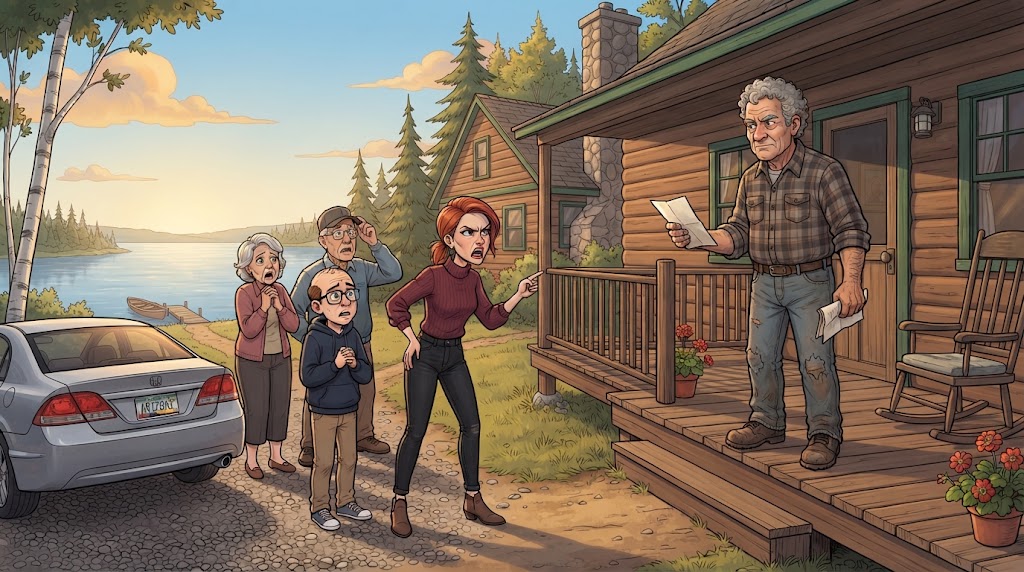
I retired and built a cabin in northern Minnesota to finally have peace, but then my daughter-in-law called her parents and said the cabin was theirs. I did not say a single word right away, but when they finally showed up expecting a free home, they found exactly what I had prepared for them.
I retired at sixty-three after working thirty-one years for a structural design firm down in Cincinnati, Ohio. I did not throw a party, nor did I cry at my desk when the final hour arrived. I simply shook a few hands, packed my coffee mug along with the framed picture of my late wife into a cardboard box, and drove home into the quiet evening.
That was the entirety of my career, thirty-one long years, fitting neatly into a single box I could carry with one arm.
My wife was named Joanne, and she was the kind of woman who used to hum softly while brewing morning coffee without even realizing she was doing it. She passed away four years before I retired due to pancreatic cancer, lasting just eight short weeks from her initial diagnosis to her funeral.
I still have not fully processed that sudden loss, and I have stopped pretending that I ever will. What I did figure out was what I wanted to do with the second half of my life.
Joanne and I had talked about this dream for decades, specifically about a plot of land in northern Minnesota, roughly forty minutes east of Duluth. It was eleven acres on a quiet glacial body of water called Lake Pinecrest. It had a weathered wooden dock, a stand of tall white pines that smelled like cold air, and a silence so complete that you could hear a loon calling from the far shore on a calm morning.
We had camped there twice years ago when our son was still young enough to think catching panfish was the most thrilling thing a person could do.
I bought the property eighteen months after Joanne died, and it took me another two years to build the retreat. It was a modest two-bedroom home with a wraparound porch and a fieldstone fireplace that I laid myself with the help of a retired bricklayer named Howard, who lived twelve miles up the road and charged me in homemade venison stew.
The place was not fancy, but every single board, window, and stone was mine. I knew exactly where the hardwood floor creaked, and I knew how the light came through the east window at seven in the morning to cast a long amber stripe across the kitchen table.
I knew that house the way a man only knows something he built with his own hands and his own grief.
My son, Luke, is a good man who is thirty-four now and works as an inventory director down in Louisville, Kentucky. He married his wife, Megan, six years ago in a small backyard ceremony in Carmel, Indiana.
I liked Megan well enough at first because she was sharp, organized, and clear about what she wanted out of life. I even told Luke on the drive home that night that he had married someone with strong opinions, and he laughed while telling me that was exactly what he needed.
I truly believed him back then.
The first two years were easy, like when we spent Christmas at the lake together with a baked ham and a jigsaw puzzle that took four days to finish. I also drove down to Louisville for Thanksgiving, so things felt completely normal and comfortable, just like a family should feel when no one is pushing boundaries.
Then Megan’s parents relocated from Tucson, Arizona, after her father took an early retirement package at fifty-eight from his corporate sales job, while her mother had never worked outside their home.
They had sold their Arizona house at a substantial profit, and the story I received secondhand through Luke was that they were planning to buy a home near Louisville to be close to their daughter.
That plan shifted drastically without my knowledge.
I found out about the shift on a cold Tuesday afternoon in early October while resting at the retreat after splitting firewood, which is a habit that clears my head better than any medication.
My phone rang, and it was Megan.
“We need to talk about the lake house,” Megan said without even saying hello first.
“Okay,” I replied, setting down my glass of water. “What about it?”
“My parents are between houses right now because the purchase they were making fell through,” Megan explained. “They need somewhere to stay, so we want them to use the lake house until they find a new place.”
“How long are we talking about?” I asked after taking a long breath.
“I do not know for sure,” Megan said. “A few months, maybe through the spring.”
I did not feel sudden rage in that moment, but rather a cold quiet that happens when someone says something so unreasonable that your brain needs time to process it.
“This is my permanent home,” I told her firmly. “It is not a vacant holiday rental.”
“I know that,” Megan replied, tightening her tone. “But they are family.”
“They are your family,” I reminded her. “I have only met them twice in six years.”
“I think you are being selfish because they have nowhere else to go right now,” Megan said.
“They have a daughter with a four-bedroom house in Louisville,” I pointed out. “That seems like a reasonable place to stay.”
“There is not enough room here,” Megan claimed after a brief silence.
I did not bother arguing that point even though their large house held only two adults, because I realized her parents’ convenience was the real priority. They had experienced a failed real estate deal, which happens to people all the time, yet their proposed solution was taking over my eleven acres and my fireplace.
“I will think about it,” I said, which was the most honest answer I could give because I was already planning my response.
After hanging up, I sat on the porch for an hour while watching a blue heron stand still on the far bank before it flew away over the pines.
Joanne would have looked at me over her reading glasses and told me that I knew exactly what was happening, so I should not pretend otherwise.
I called my son that evening, and he picked up right away.
“Hey Dad,” Luke said. “I had a feeling you might call me tonight.”
“Did you know about this idea before Megan called me today?” I asked.
“She brought it up earlier,” Luke admitted after a brief pause. “I told her that she needed to talk to you directly, and I warned her that you probably would not agree to it.”
“I appreciate you being honest with me,” I said.
“Dad, I am not going to pressure you about this at all,” Luke assured me. “It is your property and your life.”
“I have not made a final decision yet,” I said. “I just wanted to make sure where you stood.”
“I stand with you,” Luke said warmly. “Whatever you decide to do, I support you completely.”
That reaction meant everything to me because Luke is a good man who inherited his mother’s fair nature.
What I decided over the next few days was not to react impulsively, which is a habit I developed during thirty-one years of structural engineering. When you deal with structural loads, you gather data and assess the situation fully before moving a single beam.
I started by calling Howard, the old bricklayer who knew everyone in the county.
“Howard, do you happen to know of any decent short-term rentals around here for a couple needing three to five months?” I asked.
 PART 2