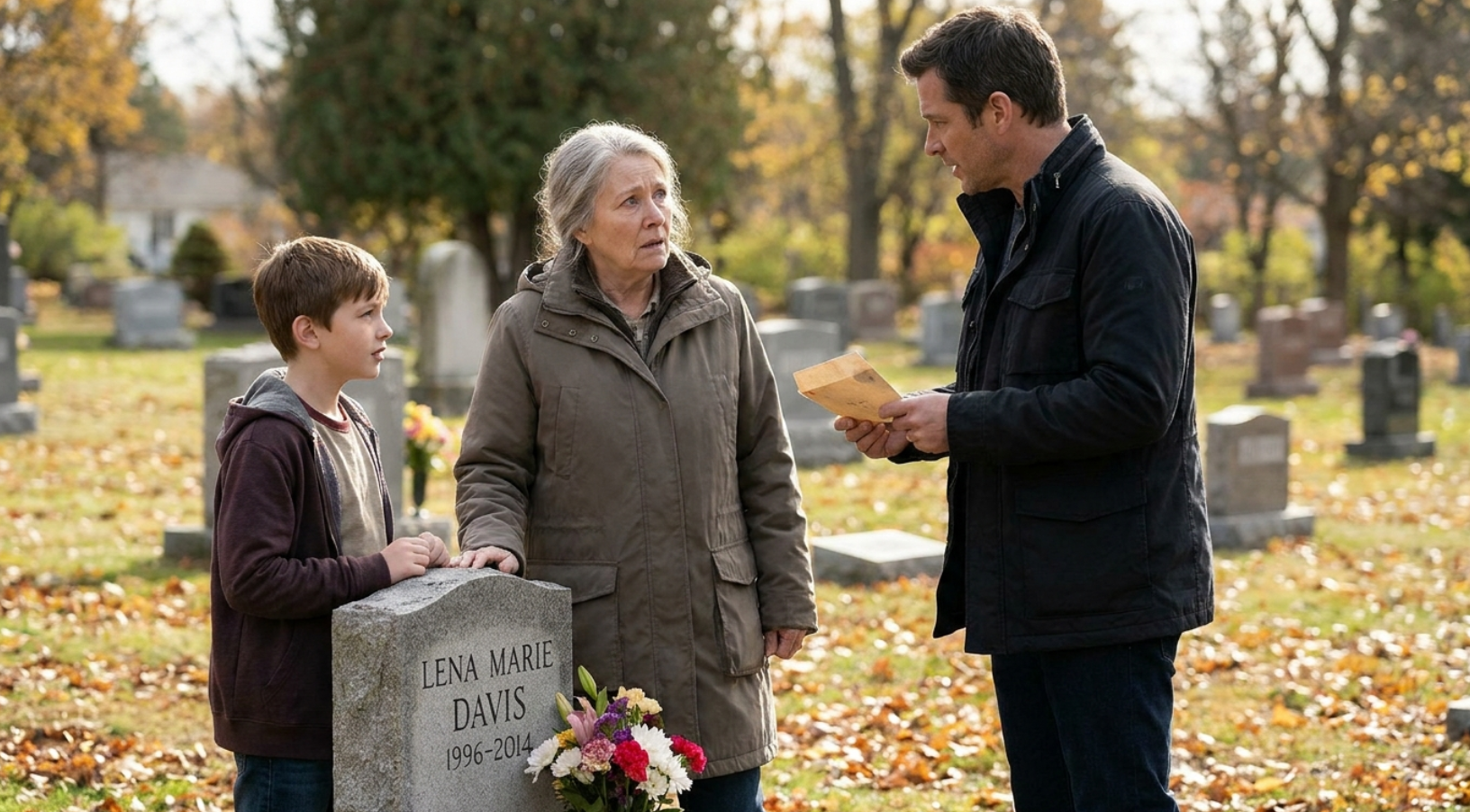
For ten years, I believed the hardest thing I would ever do was bury my daughter.
I was wrong.
The hardest thing was raising her little boy while knowing there were questions I couldn’t answer.
Questions about the woman who had given him life.
Questions about the man who had never come to claim him.
And questions about why an eighteen-year-old girl had gone through the most frightening experience of her life without telling me everything.
My name is Judith Mercer.
My daughter was Lena.
And my grandson, Miles, was the reason I continued getting out of bed after she died.
That morning, we were standing at the cemetery.
Miles had brought a birthday card for his mother.
He always took his cards seriously.
He pressed them flat, checked the corners, and carried them carefully so they wouldn’t bend.
I had watched him do that at our kitchen table before we left.
Now he held the card against his coat.
He was ten years old.
Ten years since I had heard Lena’s voice.
Ten years since I had sat in a hospital corridor, waiting for news that never came the way I wanted.
Sometimes I could still remember the doctor’s expression more clearly than his words.
I remembered looking past him toward the room where my daughter had been.
I remembered being told there was a baby.
A boy.
And I remembered wondering how a person could feel grateful and destroyed in the same moment.
That baby was standing beside me now.
He had Lena’s eyes.
I noticed them most when he was thinking.
He would narrow them slightly, as though he believed an answer might appear if he looked hard enough.
He did that whenever he asked about his father.
I had never been able to give him much.
I knew Lena had loved someone.
I knew she had been frightened during her pregnancy.
But she had never told me who the young man was.
I had tried to understand her silence.
Some days, I thought she had been protecting him.
Other days, I wondered whether he had abandoned her.
Neither possibility brought me peace.
Miles touched my hand.
“Grandma, do you think Mom would like the card?”
I looked down at him.
“I think she’d keep it forever.”
He nodded and turned toward the headstone.
He was quiet while he placed his card there.
I stood a little behind him.
That was something I had learned about grief.
Sometimes the kindest thing you could give another person was room.
Miles didn’t cry every time we visited.
Sometimes he talked.
Sometimes he asked questions.
Sometimes he only stood there, looking at his mother’s name.
I never told him what to feel.
I had spent enough years being told that time would make everything easier.
Time had done some things.
It had taught me how to pack school lunches.
How to check homework.
How to sit through baseball games and pretend I wasn’t nervous every time Miles stepped up to bat.
It had taught me how to smile when other children ran toward their mothers.
But it had not taught me how to stop missing Lena.
I was looking at her name when I noticed the woman.
She stood a short distance away.
She wasn’t looking at another grave.
She was looking at us.
At first, I thought she might be waiting for someone.
Then she moved closer.
She was older, neatly dressed, with a handbag held tightly in both hands.
There was something about the way she watched Miles that made me uncomfortable.
It wasn’t simple curiosity.
It looked more like recognition.
I moved slightly closer to my grandson.
The woman stopped.
“Are you Judith Mercer?”
I didn’t answer immediately.
“Who wants to know?”
“My name is Marianne.”
She looked at Miles again.
“I’ve been hoping to find you.”
I felt my shoulders tighten.
“Do we know each other?”
“No.”
She swallowed.
“But I knew your daughter.”
Those words were enough to make me stand still.
For ten years, people had spoken about Lena as someone who belonged entirely to the past.
They remembered her as a student.
A girl who liked books.
A young mother who had died before she had a chance to hold her child for very long.
But this woman said she had known her.
Not remembered her.
Known her.
I glanced toward Miles.
He was watching us.
I took his hand.
“Sweetheart, could you sit over there for a little while?”
He looked toward the bench near the path.
“Why?”
“Because I need to have a conversation.”
He hesitated.
Then he asked the question I had heard in one form or another for years.
“Is it about my father?”
I felt my throat close.
I knelt so I could look at him properly.
“I think it could be.”
He studied my face.
Then he walked to the bench.
I watched until he sat down.
Only then did I turn back.
“Tell me why you’re here.”
Marianne nodded.
She opened her handbag slowly.
I watched her hands.
They were trembling.
She removed a photograph.
The paper looked old.
It had softened around the corners, the way photographs do when someone has held them too often.
She handed it to me.
At first, all I saw was Lena.
My daughter.
Alive.
Laughing.
She stood outside a brick building, with her head tipped toward a young man beside her.
Her hand rested against his jacket.
I recognized the expression on her face.
She looked comfortable.
Happy.
There was no effort in that smile.
I couldn’t remember the last time I had seen a photograph of her that was new to me.
For a moment, I forgot Marianne was standing there.
I looked at Lena’s hair.
Her cheeks.
The slight tilt of her head.
Then I noticed the building.
It was the old public library in Cambridge.
Lena had studied there after school.
She used to come home with books tucked under her arm, sometimes later than I expected.
I had assumed she was working hard for her examinations.
Perhaps she was.
But she had also been meeting someone.
“Where did you get this?”
Marianne glanced at the picture.
“It was taken ten years ago.”
I looked at the young man.
“Who is he?”
She seemed to struggle with the answer.
Then she said it.
“Daniel Vale.”
I waited.
The name meant nothing to me.
Marianne’s eyes filled.
“He’s my son.”
I looked at her.
Then at the photograph.
Then back at her.
For a moment, I couldn’t understand why she had come all this way to show me a picture of her son.
Then I looked again at Lena’s hand.
At the way Daniel stood beside her.
At the way she smiled up at him.
A terrible possibility began to settle over me.
“You’re telling me your son knew Lena?”
Marianne nodded.
“They were together.”
I tightened my grip on the photograph.
“How together?”
“They loved each other.”
I wanted to reject the answer.
Not because Lena couldn’t have loved someone.
Of course she could.
She was eighteen, but she had a heart of her own.
Dreams of her own.
A life I had never completely understood.
What frightened me was the thought that this woman might know something I had spent ten years trying to discover.
“Was he the baby’s father?”
Marianne looked toward Miles.
Her face changed.
“I believe Daniel is his father.”
I couldn’t speak.
There were moments in my life when everything had changed because of a few words.
The doctor telling me Lena was gone.
The nurse telling me her son had survived.
Miles asking why the other children had fathers at their baseball games.
And now this.
A stranger in a cemetery telling me my grandson might have a family I had never known existed.
I looked down at the photograph again.
Lena had never mentioned Daniel Vale.
Not once.
I searched my memory for the name.
For a forgotten telephone call.
A letter.
A conversation at the kitchen table.
Nothing.
“How old was your son when he met her?”
“Twenty.”
“Where?”
“At that library.”
Marianne pointed toward the photograph.
“He was studying in Boston. Lena was preparing for her exams.”
I kept staring at the building.
I knew that place.
I had dropped Lena off near it.
I had picked her up when the weather was bad.
I could picture her walking through those doors.
But I had never pictured the young man waiting inside.
Marianne continued.
“Daniel spoke about her constantly.”
I looked up.
“Then why didn’t I ever hear about him?”
She lowered her eyes.
“Because our family made it difficult for them to stay together.”
I felt anger rise.
“Difficult?”
She nodded.
I looked toward Miles.
He was sitting on the bench, swinging one foot.
He had no idea how much depended on the conversation taking place a few yards away.
I turned back to Marianne.
“My daughter died bringing that boy into the world.”
My voice shook.
“I was there when she needed someone. I was the one who brought him home. I was the one who stayed awake when he cried.”
Marianne said nothing.
“I have spent ten years wondering who his father was.”
I stepped closer.
“So don’t stand here and tell me things were difficult.”
Her face tightened.
“I know.”
“No, you don’t.”
I looked down at the photograph.
My daughter looked so young.
That was what hurt most.
She hadn’t looked like someone prepared to carry a secret that large.
She had looked like a girl who believed the future could still turn out well.
I held the photograph between us.
“Start at the beginning.”
Marianne nodded.
And that was when she told me about her husband.
His name was Richard Vale.
Until that morning, I hadn’t given the Vale family a thought.
I had no reason to.
Their money belonged to a world far away from mine.
But Marianne described a man who had built a business and then used his success to decide what everyone around him could do.
Especially his son.
Daniel’s education.
His career.
The place he would occupy in the family company.
Richard expected to control all of it.
And when Daniel fell in love with Lena, he treated her as a problem to be removed.
I stared at Marianne.
“Because she wasn’t wealthy?”
She gave a small nod.
I almost laughed.
Not because anything was funny.
Because I couldn’t believe that my daughter’s worth had been measured by a man who had never bothered to know her.
Lena had worked hard.
She read books until her eyes hurt.
She made plans.
She helped me around the house without being asked.
She could make me laugh when I was exhausted.
And Richard Vale had apparently decided that none of those things mattered.
Only her family’s money.
Only the life she couldn’t offer his son.
I looked at Lena’s smiling face.
For the first time, I wondered what she had been carrying behind that smile.
And how much of her fear I had failed to see.
Source