My in-laws demanded a DNA test to prove my 8-year-old was “really family” on Christmas—three days later, their lawyer called, and suddenly they were the ones desperate for answers
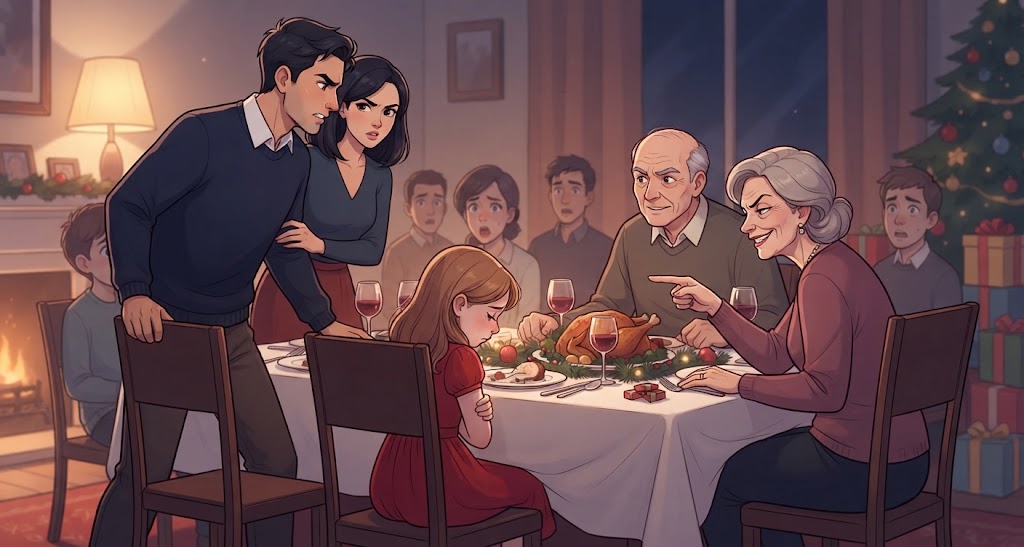
Christmas dinner had barely started when my father-in-law put down his fork and looked directly at my 8-year-old daughter.
“We need a DNA test.”
No warning.
No private conversation.
He said it right in front of Fiona.
The entire table went silent.
My mother-in-law, Janice, leaned forward with that calm little smile she used whenever she wanted cruelty to sound reasonable.
“We just need to be sure she really belongs with us.”
I felt Fiona go completely still beside me.
Her shoulders folded inward.
Her hands disappeared beneath the table.
She didn’t cry.
That somehow made it worse.
I could practically see my little girl trying to understand why her own grandparents needed proof that she belonged.
Inside, I was furious.
Outside, I stayed completely calm.
I looked at Janice.
Then Gerald.
And said one word.
“Understood.”
Janice blinked.
I think she had been expecting a scene.
Instead, my husband Samuel walked back into the dining room and immediately sensed something was wrong.
“What happened?”
Gerald answered before I could.
“Your wife is being dramatic.”
Janice added, “We simply want confirmation that Fiona is actually yours.”
Samuel’s face changed.
Not angry at first.
Still.
Dangerously still.
“What did you just say?”
His sister Kimberly shrugged.
“Don’t act like you’ve never wondered.”
That was it.
Samuel looked at Fiona.
Then at his parenTS.
“We’re leaving.”
Janice rolled her eyes.
“Oh, don’t be ridiculous.”
“You do not talk about my daughter like that.”
Gerald crossed his arms.
“We deserve clarity.
Your wife has given us reasons to question things.”
Fiona flinched again.
I stood immediately.
“Fiona, get your coat.”
She obeyed without saying a word.
As we walked out, Samuel’s 90-year-old grandmother, Agnes, sat at the table with one hand over her mouth.
She looked horrified.
Outside, Fiona climbed into the car and stared down at her mittens.
Then she whispered:
“Mom… did I do something wrong?”
That broke something in me.
“No, baby.
Not one thing.”
But the truth was, this hadn’t started that night.
For years, Janice and Gerald had treated Fiona differently from their other granddaughter, Meline.
Meline got expensive dolls, special outfits, endless praise.
Fiona got practical gifts and little comments about being “sensitive.”
Then the comparisons became something uglier.
“She doesn’t look much like Samuel.”
“You never know these days.”
“Wouldn’t everyone feel better with proof?”
We kept trying to ignore it.
Until they finally said it directly to her face.
When we got home that night, Samuel canceled the monthly money he had been sending his parenTS.
Then his phone rang.
Unknown number.
He answered.
“Yes, this is Samuel.”
A pause.
His posture changed.
“Tomorrow morning?”
He looked at me.
“We’ll be there.”
When he hung up, I asked who it was.
“My grandmother’s lawyer.”
My stomach tightened.
“Is Agnes okay?”
“I think so.”
Then Samuel sat down beside me.
And finally told me something he had never explained.
A few months earlier, Agnes had mentioned wanting to leave Fiona something someday.
A gift.
Nothing dramatic.
Just something because she loved her.
Janice had overheard.
And apparently, she had lost it.
Samuel looked sick as he repeated what his mother had said.
“Before any money goes to that child, we need proof.”
That child.
Suddenly the DNA demand made sense.
This was never really about Fiona’s face.
It was about inheritance.
The next morning, after dropping Fiona at school, Samuel and I drove to the lawyer’s office.
Agnes was already sitting inside.
She looked different.
Not fragile.
Not confused.
Furious.
The lawyer closed the door behind us.
Then he placed a thick folder on the table.
“Agnes asked me to make changes to her estate planning.”
Samuel stared at his grandmother.
“Because of last night?”
Agnes nodded.
“They questioned that child’s place in this family,” she said.
“They hurt her.
And I will not reward people for that.”
The lawyer opened the folder.
Then he looked directly at us.
“What happened at Christmas has changed what Agnes intends to do with everything she owns.”
Samuel reached for my hand.
And in that moment, I realized Janice and Gerald had demanded proof that Fiona belonged in their family…
without understanding what that demand might cost them.
The lawyer didn’t speak for several seconds.
He simply rested both hands on the thick folder in front of him and looked at Samuel.
Then at me.
Then finally at Agnes.
“Before we continue,” he said, “I want to make one thing very clear.
Agnes is making these decisions voluntarily.
She has been evaluated, she understands exactly what she owns, exactly who her beneficiaries are, and exactly what these changes mean.”
Samuel immediately shook his head.
“Grandma, you don’t have to change anything because of us.”
“I’m not doing it because of you.”
Agnes’s voice was quiet.
But there was steel in it.
“I’m doing it because of Fiona.”
That silenced the room.
Agnes folded her hands in her lap.
“For eight years, I watched that little girl walk into family gatherings wanting nothing except to be loved.
I watched her bring Janice drawings.
I watched her save Gerald a seat at her school recital.
I watched her make Christmas cards for people who could barely bother to buy her a thoughtful gift.”
My throat tightened.
Agnes continued.
“And yesterday, those people looked at an eight-year-old child and told her she needed scientific proof to deserve a place at their table.”
Samuel stared at the floor.
Agnes looked at him.
“You should have stopped this sooner.”
He flinched.
“I know.”
“No,” Agnes said.
“I don’t think you did.
But I think you do now.”
Samuel nodded slowly.
“I do.”
Then Agnes turned toward me.
“And you kept quiet to keep the peace.”
I swallowed.
“Yes.”
“There was never any peace,” she said gently.
“There was only Fiona paying the price for everyone else pretending there was.”
That sentence stayed with me.
Because she was right.
Every awkward smile.
Every ignored comment.
Every Christmas where Meline opened five beautiful presents while Fiona opened one sweater and thanked everyone politely.
Every time Janice said Fiona was “too sensitive.”
We had called our silence maturity.
But Fiona had experienced it as abandonment.
The lawyer opened the folder.
“Agnes has revised her estate plan.”
He turned several pages.
“The lake house will be placed into a trust for Fiona.”
Samuel’s head snapped up.
“What?”
Agnes didn’t react.
The lawyer continued.
“The investment account previously designated to Janice will also be transferred into that trust.”
I stared at him.
I knew Agnes was comfortable.
I had no idea how comfortable.
“And the remaining liquid assets,” he said, “will be divided between Fiona’s educational trust and two charities Agnes has selected.”
Samuel looked stunned.
“What about Mom?”
The lawyer glanced at Agnes.
Agnes answered herself.
“Janice gets my china.”
For one second, nobody said anything.
Then I almost laughed.
Not because it was funny.
Because it was so perfectly Agnes.
Samuel rubbed a hand over his face.
“Grandma…”
“She likes to remind everyone that china has been in the family for generations,” Agnes said.
“Now she can have all of it.”
“And Dad?”
Agnes’s expression hardened.
“Gerald isn’t my son.”
Of course.
He was Janice’s husband.
“He was never entitled to anything.”
The lawyer closed the folder.
“There’s another provision.”
Something in his tone made me sit straighter.
“Agnes anticipated that the changes might be challenged.
The trust contains a contest clause.
Anyone attempting to interfere with the estate plan or harass the beneficiaries regarding their inheritance risks forfeiting anything otherwise left to them.”
Samuel exhaled slowly.
“So they can’t bully Fiona.”
“They can try,” the lawyer said.
“But it would be an extremely expensive mistake.”
Agnes smiled for the first time that morning.
“Good.”
Then she reached across the table and took my hand.
“I want you to promise me something.”
“Anything.”
“Do not tell Fiona about the money.”
I blinked.
Agnes squeezed my fingers.
“She is eight years old.
She should know I love her.
She should not grow up wondering whether people love her because of what she may inherit.”
I nodded immediately.
“I promise.”
“Let her be a child.”
“I will.”
Three days later, Janice called.
Not Samuel.
Me.
I almost didn’t answer.
But something told me to.
“Hello?”
There was no greeting.
“What did you do?”
Her voice was shaking.
I leaned against the kitchen counter.
“Excuse me?”
“Don’t play stupid with me.
Mother changed her will.”
So that was why she was calling.
Not Fiona.
Not an apology.
Money.
“I didn’t ask Agnes to change anything.”
“You expect me to believe that?”
“Yes.”
“You poisoned her against us.”
“No, Janice.”
I looked through the kitchen doorway.
Fiona was on the living-room floor building a miniature castle from blocks.
Completely unaware.
“You did that yourselves.”
Janice went silent.
Then her voice dropped.
“This is hundreds of thousands of dollars.”
I said nothing.
Apparently, my silence answered enough.
“She was going to leave that account to me.”
“Then maybe you should ask yourself why she changed her mind.”
“You think one uncomfortable Christmas conversation justifies stealing my inheritance?”
There it was.
Not one word about Fiona.
I felt whatever guilt I had left disappear.
“Your inheritance?”
“She’s my mother.”
“And Fiona is your granddaughter.”
“Assuming she actually—”
I hung up.
Immediately.
My hands were shaking.
Samuel walked into the kitchen.
“Mom?”
I nodded.
He held out his hand.
“Give me your phone.”
I did.
He blocked her number.
Then Gerald’s.
Then Kimberly’s.
No speech.
No debate.
Just two taps.
That evening, the doorbell rang.
Gerald was standing on our porch.
Janice was behind him.
Samuel stepped outside and closed the door behind him.
I stayed inside with Fiona, but I could hear their voices through the window.
“You are destroying this family,” Gerald said.
Samuel laughed once.
It wasn’t a happy laugh.
“You asked my eight-year-old daughter for a DNA test at Christmas dinner.”
“We had legitimate concerns.”
“No.
You had financial concerns.”
Silence.
That silence told Samuel everything.
Then Janice spoke.
“Samuel, please.
Your grandmother is ninety years old.
She’s emotional.
She’s being manipulated.”
“By whom?”
Another silence.
“Your wife.”
Samuel’s answer came instantly.
“No.”
“You’ve always taken her side.”
“She’s my wife.”
“I’m your mother!”
“And Fiona is my daughter.”
Janice’s voice cracked.
“What if she isn’t?”
This time Samuel was silent.
Then he said something I will never forget.
“She became my daughter the first time I held her.
She became my daughter every morning I made her breakfast.
Every nightmare I sat through.
Every fever.
Every birthday.
Every school pickup.
Every time she called me Dad.”
His voice became colder.
“A lab doesn’t get to decide whether I love my child.”
Janice said nothing.
“And neither do you.”
Gerald muttered something I couldn’t hear.

Then Samuel said:
“You need to leave.”
“Samuel—”
“Leave.”
They did.
But it wasn’t over.
Two days later, Agnes’s lawyer called us again.
This time, his voice sounded different.
Almost amused.
“Samuel, I received an interesting call from your parents’ attorney.”
Samuel put the phone on speaker.
“What kind of call?”
“They’re considering challenging Agnes’s competency.”
Samuel’s expression darkened.
I felt sick.
“They want to declare her incompetent?”
“That appears to be the direction.”
“They’re going after a ninety-year-old woman because she changed her will?”
The lawyer paused.
“Yes.”
Then he added:
“But there’s a problem.”
“What problem?”
“Agnes anticipated that.”
Of course she had.
The woman had survived ninety years.
Janice had mistaken age for weakness.
The lawyer explained that Agnes had undergone an independent medical evaluation before signing anything.
Then a second evaluation.
The signing had been recorded.
Two witnesses had been present.
Every major decision had been documented.
And Agnes had written a personal statement explaining exactly why she had changed her estate plan.
Samuel closed his eyes.
“What did she write?”
The lawyer hesitated.
“I think you should hear that from her.”
The following Sunday, Agnes came to our house for dinner.
Nothing fancy.
Roast chicken.
Mashed potatoes.
Green beans.
Fiona insisted on making dessert.
Chocolate pudding with far too many sprinkles.
Agnes ate every bite.
Afterward, Fiona brought her a folded piece of paper.
“I made you something.”
Agnes opened it.
It was a drawing.
Four stick figures holding hands.
Me.
Samuel.
Fiona.
Agnes.
Above them, in purple crayon, Fiona had written:
MY FAMILY.
Agnes stared at it for a long time.
Then she asked:
“May I keep this?”
Fiona smiled.
“That’s why I made it.”
Agnes started crying.
Quietly.
She pulled Fiona into her arms.
And I realized something.
Janice and Gerald had demanded DNA because they believed biology gave them ownership over the word family.
But Fiona understood family better at eight years old than they did after sixty years.
Family was who showed up.
Who protected you.
Who made room for you.
Who never asked you to prove you deserved love.
The next morning, Samuel received an email from his parents’ attorney.
They had withdrawn their threat to challenge Agnes’s estate.
Apparently, their own lawyer had explained the situation very clearly.
They were unlikely to win.
They could spend tens of thousands trying.
And if their actions triggered the contest clause, Janice could lose even the smaller items Agnes had left her.
But there was one more surprise.
The DNA test.
Janice still wanted it.
She sent Samuel an email.
“If you are so certain, then prove it.”
Samuel showed it to me.
I read it twice.
Then I asked him a question.
“Do you want to know?”
He looked toward the backyard.
Fiona was outside chasing bubbles.
“No.”
“Really?”
“Really.”
Then he looked at me.
“But maybe someday Fiona will.”
That mattered.
Because this wasn’t about Janice anymore.
It was Fiona’s biology.
Her information.
Her choice.
So we made a decision.
We would not test an eight-year-old child to satisfy adults who had humiliated her.
If Fiona wanted answers when she was older, we would support her.
But nobody was going to turn her DNA into an admission ticket to a family that had already failed her.
Samuel replied with one sentence:
“Fiona has nothing to prove to you.”
Then he blocked their email addresses.
Months passed.
Christmas became spring.
Spring became summer.
Fiona changed.
At first, she stopped asking about her grandparenTS.
Then she stopped noticing their absence.
She spent more time with Agnes.
Every Saturday they had what Fiona called “Great-Grandma Days.”
They baked.
They watched old movies.
Agnes taught Fiona how to play gin rummy and accused her of cheating whenever Fiona won.
“I’m eight,” Fiona would say.
“That doesn’t mean you’re innocent,” Agnes would reply.
I had never seen either of them happier.
Then, one afternoon, Agnes asked Samuel and me to bring Fiona to the lake house.
The property sat beside a quiet stretch of water surrounded by pine trees.
Fiona ran straight toward the dock.
“Can we swim?”
“In June,” Agnes called after her.
“It’s May!”
“Exactly!”
Fiona groaned dramatically.
Agnes laughed.
Then she looked at Samuel.
“This house will be hers someday.”
Samuel shook his head.
“Grandma, she doesn’t need a house.”
“I know.”
“Then why?”
Agnes watched Fiona standing at the end of the dock.
“Because every child deserves one place in the world where nobody can tell them they don’t belong.”
I had to look away.
A year later, Agnes died peacefully in her sleep.
She was ninety-one.
Fiona was holding my hand at the funeral.
Janice came.
So did Gerald.
They stood across the room from us.
For the first time in a year, Janice looked directly at Fiona.
Fiona looked back.
Then she turned toward Samuel.
“Dad?”
“Yes, sweetheart?”
“Can we go see Great-Grandma’s flowers?”
“Of course.”
She took his hand.
Janice watched them walk away together.
I don’t know what she felt.
Regret, maybe.
Anger.
Maybe both.
But for once, nobody rushed to comfort her.
The estate was settled exactly as Agnes had planned.
There was no lawsuit.
No dramatic courtroom battle.
No last-minute victory for Janice.
Just paperwork.
Signatures.
Consequences.
Janice received the family china.
Every plate.
Every cup.
Every saucer.
Agnes had also left her one handwritten letter.
I never saw the entire thing.
But Janice later told Kimberly one line from it.
And Kimberly eventually told Samuel.
It said:
“You spent Christmas asking whether Fiona deserved to inherit from this family.
You never stopped to ask whether you deserved to.”
That was Agnes.
Even from the grave, she knew exactly where to place the knife.
Figuratively, of course.
But the final twist came almost two years later.
Fiona was ten.
One evening, she was doing a school project about family trees.
She came into the kitchen holding the worksheet.
“Mom?”
“Yeah?”
“Why did Grandma Janice think Dad wasn’t my real dad?”
My heart stopped.
We had never lied to her.
But we had waited until she was old enough to ask.
So Samuel and I sat down with her.
We explained biology.
DNA.
Parenthood.
And what had happened that Christmas in language a ten-year-old could understand.
Fiona listened carefully.
Then she asked:
“Can I do the test?”
Samuel went quiet.
I asked, “Are you sure?”
She nodded.
“I don’t care what Grandma thinks.
I just want to know because it’s mine.”
That was enough.
So we did it.
Privately.
No announcement.
No audience.
When the results arrived, Samuel sat beside Fiona at the kitchen table.
She opened the envelope herself.
Probability of paternity:
99.99%.
Fiona stared at the number.
Then at Samuel.
“So you’re definitely my dad?”
Samuel smiled.
“I was definitely your dad before we opened the envelope.”
She grinned.
“I know.”
Then she asked the question neither of us expected.
“Can I send Grandma a copy?”
Samuel and I looked at each other.
“What do you think?” I asked.
Fiona thought about it.
Then she shook her head.
“No.”
She folded the paper.
“She doesn’t need it.”
“Why not?”
Fiona shrugged.
“Because Great-Grandma already knew I was family.”
I almost cried.
Samuel actually did.
Fiona rolled her eyes and hugged him.
We never sent Janice the resulTS.
She never learned what they said.
And somehow, that became the most satisfying part of all.
Because she had demanded proof as though she were entitled to it.
She wasn’t.
Fiona’s DNA belonged to Fiona.
Her identity belonged to Fiona.
And her relationship with her father belonged to the two of them.
Janice had wanted a piece of paper deciding whether Fiona deserved a place in the family.
Instead, she got a different piece of paper.
Agnes’s will.
Years later, the lake house became Fiona’s favorite place in the world.
We kept Agnes’s photograph above the fireplace.
And beside it, framed in cheap white wood, was the purple-crayon picture Fiona had drawn when she was eight.
Four stick figures.
Four people holding hands.
MY FAMILY.
The DNA results stayed locked away.
They were never framed.
Never displayed.
Never used to prove anything.
Because in the end, Gerald and Janice had been asking the wrong question.
They wanted to know whether Fiona shared their blood.
What they should have asked was whether they had behaved like her family.
DNA could answer the first question.
Christmas answered the second.
And that answer cost them everything.
Not just the inheritance.
Not just the lake house.
Not just Agnes’s respect.
They lost Saturday afternoons.
Birthdays.
School concerTS.
Graduations they would eventually hear about from other people.
They lost the privilege of watching Fiona grow into the extraordinary young woman Agnes always knew she would become.
And Fiona?
She lost nothing she actually needed.
She had a mother who would protect her.
A father who chose her long before any laboratory confirmed anything.
And a great-grandmother who made sure her final gift wasn’t simply money.
It was certainty.
Certainty that Fiona had a place where she belonged.
Years after Agnes died, Fiona once asked me why I thought her great-grandmother had left her the lake house.
I told her the truth.
“I think she wanted you to always have a home.”
Fiona looked around the old living room.
At Agnes’s photograph.
At the drawing above the fireplace.
Then she smiled.
“She already gave me one.”
And that was when I finally understood.
Janice had demanded a DNA test because she thought blood determined who belonged.
Agnes changed her will because she knew better.
Family isn’t proven by a percentage on a laboratory report.
It’s proven by who reaches for your hand when the room turns against you.
Who leaves the table with you.
Who stands between a child and cruelty.
Who looks at an eight-year-old girl and never, not even for a second, asks her to prove that she deserves to be loved.
Janice wanted proof.
In the end, she got it.
Just not the kind she expected.