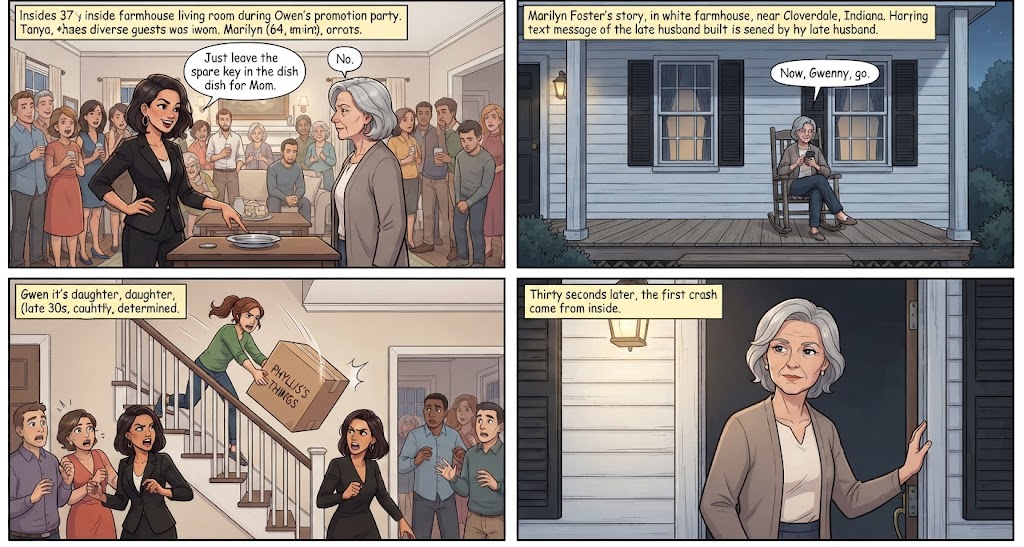
“Just put the spare key in the dish for Mom, so she can come and go.”
The music kept playing for a few seconds after Tanya’s hand came across my cheek.
That was the strangest part.
Forty-three people were standing in my living room with drinks in their hands, a caterer was moving between my kitchen and dining room, and somebody had just laughed at something near the back of the room. Then the sound landed, and everything around me seemed to lose its shape.
I held on to the glass of water in my hand.
Across the room, my son stared at the floor.
His name was Owen. He was thirty-seven years old, and I had raised him in this house. I had sat beside his bed through fevers, driven across Indiana to pick him up when his first car broke down, and once let him sleep with his head in my lap for half a night because a thunderstorm had frightened him when he was little.
Now his wife had crossed a line in front of forty-three people, and Owen would not look at me.
That hurt more than my cheek.
I set the water down.
Tanya was still standing beside the folding table she had placed in the middle of my living room. On it sat a decorated cake and a small silver dish she had brought from somewhere. Five minutes earlier, she had announced to everyone that her mother, Phyllis, was moving permanently into my house.
Not visiting.
Not staying another week.
Moving in.
She had even told the room that I was preparing the downstairs bedroom for her.
I had agreed to none of it.
When I corrected her, Tanya laughed.
“Mom,” she said, as if I were the confused one, “we talked about this.”
“We did not.”
She reached into her purse, removed the silver dish, and placed it carefully on the table.
Forty-three faces turned toward me.
I said, “No.”
The smile left her eyes first.
“The key, Marilyn.”
“No.”
Then came the moment that changed the evening.
Afterward, nobody seemed sure where to look.
Tanya’s friends stared into their glasses. One of Owen’s coworkers shifted backward. A woman I had never met put a hand over her mouth.
Owen kept looking at the floor.
I turned toward the front door.
Tanya called my name behind me, but I kept walking.
Outside, the October air was cold enough to make my eyes water. Our porch stretched across the front of the white farmhouse Frank and I had owned for twenty-eight years, and his two handmade rocking chairs still sat side by side where he had put them.
Frank had built those chairs the summer we moved in.
He was not a carpenter. He managed inventory for a hardware distribution company. But when life became noisy, Frank went to his workshop and made things.
Bookcases.
Tables.
A headboard.
Cabinet doors.
The coffee table Tanya had pushed into the hallway to make space for her party.
And those two porch chairs.
Frank had been gone for more than two years by the time this story finally settled into what it became.
He had suffered a stroke one Wednesday afternoon while working on a cabinet door in the workshop. Gwen, our daughter, found him when she came by with groceries.
I had been playing cards at my friend Marge’s house.
When Gwen called, she said only, “Mom,” and I knew from her voice.
Some sounds stay inside you forever.
That phone call was one of them.
I crossed the porch and sat in Frank’s chair.
My hand was steady when I took out my phone.
Gwen was upstairs inside the house, waiting.
Not because we had predicted Tanya would cross that particular line. We hadn’t.
But Gwen and I had been preparing for weeks for the moment when I finally stopped allowing my home to be treated as if it belonged to everyone except me.
I typed three words.
Now, Gwenny, go.
I sent the message.
Then I placed my phone in my lap and counted.
One.
Two.
Three.
By thirty, the first crash came from inside.
To understand why my daughter was waiting upstairs surrounded by packed boxes, you have to go back eight months.
Owen called me on a Sunday evening.
His company had restructured, and his position had been eliminated. He and Tanya were three months behind on their rent. Their lease was ending.
“Mom,” he said, “could we stay with you for six months? Just until I get working again?”
I looked around the kitchen while he talked.
Frank had been gone less than a year then. I still sometimes walked into a room expecting to find him there. Some mornings, I caught myself making enough coffee for two people.
The house had become very quiet.
Owen was my son.
Of course I said yes.
They arrived on a Tuesday with two cats, stacks of cardboard boxes, and more belongings than I expected anyone to own while claiming the move was temporary.
For the first few weeks, I was glad they were there.
Owen fixed the back gate.
Tanya cooked dinner twice and left a handwritten thank-you note on the counter.
The cats found the warm spot beneath the front window.
I heard footsteps upstairs again.
For a widow still learning the difference between peace and emptiness, that mattered.
Then the changes began.
Tanya took family photographs off the hallway shelf and replaced them with a mirror.
“They were making it look cluttered,” she explained.
I put the pictures carefully in a drawer and said nothing.
She replaced my kitchen curtains.
“The old ones were dated.”
I said nothing.
She moved dishes into different cabinets because her system “made more sense.”
Again, I said nothing.
Each change was small enough to sound silly if I complained about it.
That was how the house changed.
Not in one dramatic afternoon.
One shelf at a time.
One drawer at a time.
One sentence beginning with, “I thought you wouldn’t mind.”
Then came the garage sale.
I walked outside one Saturday morning and saw clothes, lamps, kitchenware, and boxes arranged along the driveway.
Tanya had mentioned selling a few things.
I had assumed she meant hers.
Near the end of one folding table hung Frank’s tool belt.
Five dollars.
A small handwritten price tag dangled from a cracked leather loop.
I stopped in the driveway.
Frank had worn that belt for nearly twenty years. One of the holes had stretched out so badly that he had repaired it himself with an awl.
“The good ones just need a little attention,” he had told me.
I lifted the belt off the rack.
Tanya noticed.
“Oh, Marilyn, nobody uses that.”
“Frank did.”
“Well, yes, but—”
“It is not for sale.”
I carried it straight to his workshop.
That afternoon, I put a padlock on the workshop door.
Tanya never mentioned the lock.
She did not have to.
I saw her face when she noticed it.
A few weeks later, Phyllis arrived.
Tanya’s mother pulled into the driveway on a Friday afternoon with two suitcases and a carry-on bag.
No one had told me she was coming.
She climbed the porch steps and entered without knocking.
“The bigger bedroom would suit me better,” she said after walking through my house for less than ten minutes. “My hip gives me trouble on stairs.”
“You’re welcome to use the guest room upstairs.”
“I just told you stairs are difficult.”
Owen stepped between us with the nervous laugh he had started using whenever Tanya or Phyllis pushed too far.
“Mom, she can use the foldout in the den tonight. We’ll figure it out tomorrow.”
Tonight became three nights.
Then a week.
By the second week, Phyllis was asking what time I planned to make dinner.
She reorganized my pantry.
She moved my dishes.
Then she threw away the last bag of Frank’s coffee.
It had been dark roast from a small farm in Vermont, something he ordered regularly for years. After he died, I could not bring myself to buy another bag, so I had used the last one slowly.
Sometimes weeks passed without me opening it.
That was not the point.
It was still his.
When I asked Phyllis where it had gone, she shrugged.
“That old bag? It was taking up space.”
I searched the recycling bin anyway.
Trash pickup had already happened.
Gwen came over that weekend and found me sitting at the kitchen table.
Frank had built that table, too. Solid oak. He had practiced the joints on scrap wood three times before building the real thing.
Gwen sat across from me.
“Mom, how much longer are you going to let this go on?”
I ran my thumb over a small mark in the table.
“I need it to be undeniable.”
“To who?”
I looked at her.
“To me.”
Gwen was quiet.
I had spent months finding explanations.
Owen was struggling.
Tanya was stressed.
Phyllis had nowhere comfortable to stay.
I had too much space.
I was alone.
It was temporary.
Every explanation gave away another inch of my life.
“When it’s undeniable,” I said, “I need your help.”
Gwen did not lecture me.
She did not say she had warned me.
She simply asked, “What do you need?”
Over the next several weeks, we prepared quietly.
The house was mine.
The mortgage had been paid off eleven years before Frank died. After his death, the remaining ownership paperwork had been transferred properly to me.
Nobody else had a claim to the property.
I knew that.
Gwen knew that.
More importantly, my attorney confirmed it.
I also called my bank and removed Owen from a joint account I had added him to after Frank died for convenience. I reviewed the utilities and insurance. I updated documents that needed updating.
I did not threaten anyone with any of it.
I simply stopped leaving doors open that should have been mine to control.
Then Gwen and I began packing.
We did it when Owen and Tanya were away.
Their clothing went into labeled boxes.
Shoes into bags.
Toiletries together.
Phyllis’s belongings from the den were packed separately.
Nothing was discarded.
Nothing was damaged.
Nothing disappeared.
By the time we finished, almost everything they owned inside my house could be moved quickly if it became necessary.
Gwen wanted me to give them a deadline immediately.
I wasn’t ready.
That was my mistake, and I knew it even then.
I was still hoping Owen would notice what was happening and correct it himself.
He never did.
Five days before the party, Tanya entered the kitchen and announced that she wanted to host “a small gathering” for Owen.
He had received a new job opportunity, and she wanted to celebrate.
“How small?”
“Just a few people.”
I should have asked for a number.
Instead, I said yes to the dining room.
On the evening of the party, cars kept arriving.
Ten guests became twenty.
Twenty became thirty.
By the time I counted forty-three people, the caterer was already using my kitchen.
Someone had moved Frank’s coffee table into the hallway.
A folding table appeared in the living room.
The cake sat in the middle.
Tanya floated through the crowd in a red dress as if the farmhouse belonged to her.
Owen looked uncomfortable, but whenever our eyes met, he looked away quickly.
I said nothing.
Then Tanya tapped a spoon against her glass.
The conversations faded.
“I have one more piece of exciting news,” she announced.
Phyllis stood near the den doorway smiling.
Tanya continued.
“Mom is finally going to stop bouncing around and move in permanently.”
Several people applauded.
I felt my fingers tighten around my water glass.
“She’ll have the downstairs room,” Tanya said. “Marilyn and I already discussed making the arrangement more practical.”
Every face turned toward me.
“That’s not accurate, Tanya.”
A few smiles disappeared.
Tanya laughed.
“Mom, we talked about this.”
“We did not.”
“Yes, we did.”
“No.”
That was when she produced the silver dish.
“Just put the spare key in the dish for Mom, so she can come and go.”
“No.”
“The key, Marilyn.”
“No.”
Her expression changed.
Then came the moment that sent me outside to Frank’s chair.
Thirty seconds after I texted Gwen, something heavy struck the floor upstairs.
Then another sound followed.
Someone near the front door looked toward the staircase.
A woman whispered, “What is happening?”
I stood up.
“Yes,” I said. “I know.”
When I walked back inside, Gwen was standing at the top of the stairs.
Two boxes sat in front of her.
She pushed them forward.
They bumped down several steps, tipped at the landing, and opened. Scarves, shoes, and a few bottles slid across the entryway floor.
Tanya spun around.
“What are you doing?”
Gwen did not raise her voice.
“Your belongings are packed. All of them.”
Another bag came down.
Then another.
Owen stared up at his sister.
Phyllis stepped out of the den.
“You can’t do this. This is family.”
I looked around my living room.
Forty-three guests.
A cake I had not ordered.
A caterer I had not hired.
Furniture moved without permission.
A silver dish waiting for a key to a house Phyllis did not own.
And my son still standing exactly where he had been standing.
I walked to the bottom of the staircase.
“You have thirty minutes to collect your things and go.”
Tanya stared at me.
“You’re throwing us out?”
“I’m asking you to leave my house.”
“You’re being cruel.”
I looked at her.
“You crossed a line in front of forty-three people over a house key. I’m asking you to leave. Those are not the same thing.”
Nobody said anything.
Then one of Owen’s coworkers set his drink on the table and reached for his coat.
Another couple followed.
Within minutes, people began leaving in small groups.
Some avoided my eyes.
A few did not.
One man I recognized from Owen’s office stopped near me.
“I’m sorry, Marilyn,” he said. “I should have said something.”
A woman I did not know touched my arm lightly.
“Take care of yourself.”
The caterer packed his equipment without needing to be asked.
Owen and Tanya began carrying their belongings outside.
Four trips.
During the first two, Tanya argued.
During the third, she cried.
During the fourth, she said nothing.
Phyllis called for a ride and stood beside her suitcases near the porch.
She did not say goodbye.
Eventually, the front door opened again and Owen came inside alone.
The house was almost empty of guests.
The cake remained on the table.
He stood in the entryway holding his car keys.
“Mom.”
I waited.
He finally looked directly at me.
“I should have stopped her.”
I said nothing.
“I should have stopped all of it months ago.”
“Yes.”
His face changed.
For a moment he looked so much like Frank around the eyes that I had to look at the staircase.
“I don’t know how to fix this.”
“I don’t either,” I said. “Not tonight.”
He nodded.
Then he reached into his pocket.
My spare key lay in his palm.
He placed it in mine.
“I’m sorry, Mom. I mean it.”
I closed my fingers around the key.
I believed him.
Believing an apology did not mean everything was repaired.
That distinction mattered.
I had loved Owen before he could speak. I had sat beside a hospital bed for six hours when he was nineteen. I had worried over him, prayed for him, lent him money, opened my home, and given him more chances than I could count.
None of that disappeared.
Neither did what had happened.
“Good night, Owen.”
He stood there another moment.
Then he left.
Gwen came downstairs after the car pulled away.
She sat beside me on the couch.
“You doing okay?”
I looked at the wreckage of the party.
The displaced furniture.
The half-empty glasses.
The silver dish still sitting beside the cake.
“Ask me in a month.”
Gwen laughed softly.
“Fair enough.”
We cleaned together.
We returned the photographs to the hallway shelf.
We pushed Frank’s coffee table back into the center of the living room.
We carried trash bags to the kitchen.
The cake went out last.
The next morning, the farmhouse felt different.
Not happy.
Not sad.
Mine.
I made coffee and opened the workshop.
Frank’s tool belt still hung exactly where I had placed it months earlier.
His chisels were lined up in the rack he had built. The hand plane sat near the edge of the workbench. His old metal pencil cup was still filled with short pencils because Frank refused to throw away anything that still worked.
I picked one up.
Then I put it back.
I carried my coffee to the porch and sat in his rocking chair.
Behind the farmhouse stretched the wildflower meadow Frank had planted during the last spring of his life.
He had come home from the garden center with bags of seed after reading about pollinators. For two weekends, he walked the back acre scattering seed and talking about what it would look like when everything came up.
He never saw the meadow at its best.
By November, most of the flowers had gone to seed.
Gwen and I walked through it one Saturday morning beneath a low gray sky. The dried stalks clicked softly against one another in the breeze.
She picked up a brown seed head.
“Dad would’ve been out here with his camera.”
“Absolutely.”
“He would’ve taken two hundred pictures and shown us every one.”
“Twice.”
She smiled.
We kept walking.
After a while she said, “I’m glad you did what you did, Mom. Even the hard parts.”
“Most days, I am too.”
Owen called several times during the months that followed.
I answered some calls and let others go.
He was staying with a friend.
He and Tanya were no longer together.
He did not present that as proof that he had changed or as a reason I should forgive everything. He simply told me.
He also told me he had started therapy.
One evening, he asked, “Do you think I could come for Thanksgiving?”
I looked at the calendar hanging beside the refrigerator.
“I’ll think about it.”
“I understand.”
There was a pause.
“Mom?”
“Yes?”
“I’m sorry. I know I already said it. I just needed to say it again.”
“I heard you.”
That was all I offered.
He accepted it.
I did not know exactly what our relationship would become. I still don’t.
But for the first time in years, the next step was not being decided for me.
One cold morning, I came downstairs and found an envelope Owen had mailed sitting among the regular mail.
Inside was a short note.
No excuses.
No request to come home.
Just an apology and a sentence saying he hoped someday he could visit when I was ready to invite him.
I folded the note and put it in the kitchen drawer.
Then I made coffee.
Outside, frost silvered the field behind the house. The wildflower meadow looked empty from a distance, but I knew the seeds were still there beneath the cold ground.
I carried my mug onto the porch.
Frank’s second rocking chair sat beside mine.
For months after he died, I had avoided sitting in his chair. It felt too much like taking a place that did not belong to me.
Now I sat down without thinking about it.
The chair moved easily beneath my weight.
I could almost hear Frank telling me I had taken long enough to figure things out.
I smiled into my coffee.
From inside the house, my phone rang.
Owen’s name appeared on the screen through the window.
I watched it ring twice.
Then I stood, went inside, and answered.
“Hi, Owen.”
There was a small pause on the other end.
“Hi, Mom.”
I leaned against the kitchen counter and looked toward the porch.
Neither of us tried to repair two years in one conversation.
We simply talked.
And when the call ended, I locked the front door behind me before carrying my coffee back outside. THE END !