“You told the planning group I couldn’t come. You told me everyone had voted against me. Then you sent me a schedule for your children.”
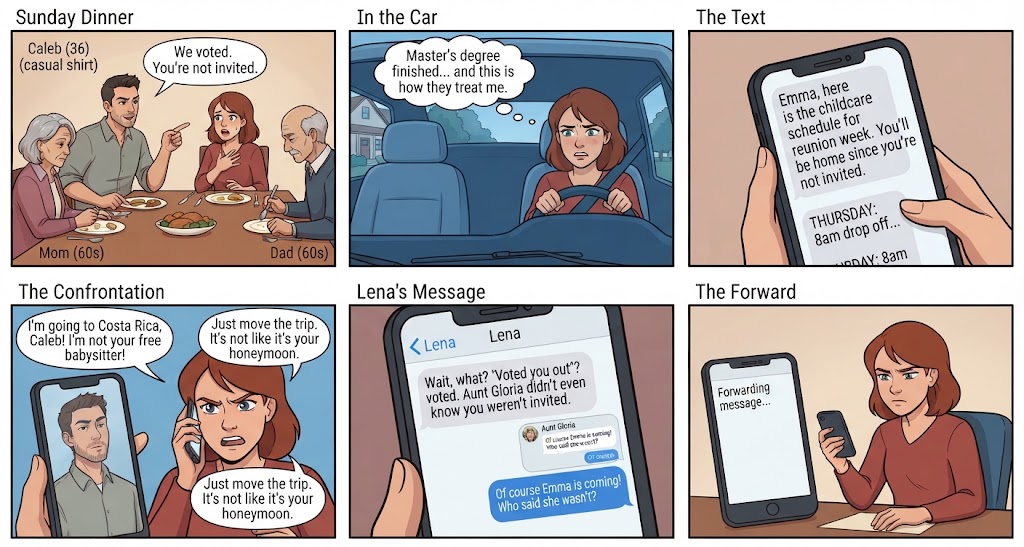
Caleb was halfway through his Sunday dinner when he told me I wasn’t welcome at our family reunion anymore. He said it with a laugh, as casually as if he’d mentioned a change in the weather. I was still holding my fork when I noticed that neither of our parents was laughing with him.
We were sitting around my parents’ dining table in Charlotte, the same table where we’d celebrated birthdays, graduations, and holidays for as long as I could remember. Mom had made roast chicken. Dad was asking Sophie about the kids’ summer activities. Everything had been perfectly ordinary until I mentioned that my cousin Lena and I were planning another kayaking race at Lake Keowee.
“I can’t wait for the reunion,” I said. “Lena’s convinced she’s finally going to beat me this year.”
Caleb leaned back in his chair. “Well, that’s going to be difficult.”
I looked over. “Why?”
“We voted. You’re not invited.”
For a moment, I waited for him to grin and admit he was kidding. My brother had always enjoyed getting a reaction out of me, especially when other people were watching. But his smile stayed in place, and nobody rushed to correct him.
“Who voted?” I asked.
“Everyone.”
Mom suddenly became interested in cutting a piece of chicken into very small bites. Dad reached for his water glass, although he had barely touched his dinner. Across from me, Sophie shifted in her chair.
“It’s mostly a space thing,” she offered.
“A space thing?”
“The cabins are tight this year,” Caleb explained. “People wanted to keep it smaller.”
There were twenty-five relatives who usually attended our Whitmore family reunion. Aunt Gloria had organized the gathering near Lake Keowee for years, coordinating cabins, meals, and activities so everyone could spend time together. I had attended almost every reunion since childhood.
I turned toward my father. “Aunt Gloria agreed to this?”
He let out a tired sigh. “Emma, don’t turn it into a thing. It’s one year.”
I looked at Mom. She wouldn’t meet my eyes.
“So everybody discussed me when I wasn’t there and decided I shouldn’t come?”
Caleb shrugged. “Basically.”
I set my fork beside my plate. Nobody had even asked whether I was available. Apparently, a decision had already been made on my behalf.
“Okay,” I said, pushing back my chair.
Mom finally looked up. “Emma—”
“I said okay.”
I picked up my purse and walked toward the front door. Behind me, Dad started saying something about people taking things too personally, but I didn’t stay to hear the rest.
By the time I reached my car, I was struggling with the simplest part of what had happened. I had expected Caleb to say something careless. I hadn’t expected both my parents to let him speak for an entire family.
My name is Emma Whitmore. I was thirty-two years old, and I worked full-time as a reading intervention specialist in Charlotte, North Carolina. For the previous three years, I had also been completing a master’s degree in literacy education.
My days started early at school, working with children who needed extra support developing their reading skills. Evenings belonged to graduate classes, research assignments, and lesson planning. Most weekends involved some combination of coursework, laundry, grocery shopping, and trying to remember what an uninterrupted night’s sleep felt like.
There were nights when I ate dinner standing at my kitchen counter because sitting down felt like an invitation to fall asleep. Once, I submitted a paper just before midnight while a load of towels sat forgotten in the washing machine. The next morning, I went to work anyway.
I wasn’t complaining. I loved what I did, and earning that degree mattered to me. But finishing it had required giving up a remarkable amount of personal time.
Seven months before graduation, I had started planning a trip to Costa Rica.
Eight days. Rainforest tours, hiking, quiet mornings, and hotels I’d carefully researched. I’d been saving for more than a year, setting aside money every paycheck and comparing flights until I found one that fit my budget.
When I finally made the reservations, I printed the confirmations and spread them across my kitchen table. It was the first vacation in years that I had organized entirely around something I wanted.
My family knew about the trip. I had talked about it through an entire semester of classes, through final projects, and through the last exhausting stretch before graduation.
Caleb knew particularly well.
He was four years older than me, married to Sophie, and the father of two children I adored. Milo was six, a curious little boy who could turn a simple walk into an investigation of every insect he encountered. Hazel was four, enthusiastic about stuffed animals and determined to explain everything she learned at preschool.
Being their aunt was one of the happiest parts of my life.
It was also the reason my brother had grown comfortable treating my time as something he could claim whenever necessary.
When Milo’s daycare closed unexpectedly, Caleb called me. When Hazel needed an afternoon pickup, he called me. If Caleb and Sophie had dinner plans, a wedding, a concert, or a late meeting, there was usually a message waiting on my phone.
In the beginning, they asked. Sometimes I agreed immediately. Sometimes we worked out a schedule. I enjoyed keeping the kids overnight occasionally, making pancakes with Milo and reading Hazel the same bedtime story three times because she insisted I wasn’t doing the voices correctly.
Eventually, the questions changed.
Instead of asking whether I was free, Caleb began asking what time I could arrive. Instead of checking my schedule, he sent me details about his.
Once, during the busiest part of my graduate program, he asked me to watch the children on a Saturday when I had a major assignment due.
“I really can’t this weekend,” I told him. “I’ve got a paper to finish.”
“Can’t you do it after they go to bed?”
“They don’t go to bed until eight.”
“Then you’ll have the whole evening.”
I ended up agreeing to a shorter visit, worked on my paper late into the night, and showed up exhausted to a Sunday study session.
Mom’s response when I mentioned it was familiar.
“It’s just easier for you, sweetheart. You don’t have children to organize everything around.”
For years, I had accepted that explanation. Caleb had a family to manage. Sophie worked, too. They were busy, and I could sometimes adjust my plans more easily.
But easier didn’t always mean easy.
Caleb had missed four of my birthday dinners in a row. The first time, he had a client event. Another year, the children were tired. The following year, something else came up. Last year, he simply forgot and sent me a cheerful birthday message the next morning.
Two days after that forgotten birthday, he asked whether I could babysit so he and Sophie could attend a concert.
I said yes.
I never held those evenings over him. I figured people with young children had complicated lives. Besides, the kids were excited to see me, and I didn’t want them disappointed.
My graduation wasn’t treated much differently. I received congratulations, certainly, but Caleb and Sophie hadn’t made the effort to celebrate with me the way I had celebrated their milestones.
I had learned to expect very little attention for my accomplishments.
Still, the reunion was different.
The Whitmore gathering had always felt like a place where the distinctions between our everyday lives disappeared. Married or single, parents or not, everyone sat together over breakfast, spent afternoons around the lake, and argued affectionately about whose turn it was to clean up.
Aunt Gloria kept things organized, but she never made anyone feel like an extra guest.
Lena, my cousin, was especially close to me. We had already been exchanging messages about our annual kayaking competition. She knew I’d been looking forward to seeing everyone.
That was why I kept replaying Sunday’s dinner on the drive home. Caleb’s announcement hadn’t sounded like a personal disagreement between siblings. He had claimed the whole family had considered my place among them and rejected it.
And my parents had sat there and let me believe him.
For the next two days, I tried not to dwell on it. I went to work, finished preparing materials for the coming school term, and focused on my travel arrangements.
My suitcase was sitting open in my bedroom. I’d laid out hiking clothes, checked the airline baggage requirements, and bought a small waterproof bag for my phone.
Then Caleb sent me a text.
It wasn’t an apology or an explanation about the reunion. It was a childcare schedule.
Thursday, 8:00 a.m., drop-off. Milo’s camp bag. Hazel’s allergy medicine and instructions. Tuesday afternoon pickup.
There were notes about bedtime routines, snacks, and which stuffed animal Hazel needed to sleep.
I read the message twice before answering.
“What is this?”
“The kids for reunion week,” Caleb wrote.
“I’m going to Costa Rica.”
A minute passed.
“That’s that week.”
“Yes, Caleb. The graduation trip I’ve talked about for seven months.”
“Then move it.”
I was sitting at my kitchen table when that message arrived. My airline confirmations were open on my laptop. I looked from the screen to the phone, trying to work out whether he was genuinely asking me to cancel an international vacation so he could attend the family gathering I’d been excluded from.
“Move my flight?” I wrote.
“You can travel later. We already made plans.”
“So did I.”
“It’s just a trip, Emma.”
I put the phone down for a minute. When I picked it up again, another message was waiting.
“You told me I wasn’t invited to the reunion.”
“Exactly.”
Then came the message that made me stop looking for an innocent explanation.
“So you’ll be home.”
I stared at those four words.
Caleb wasn’t offering me something to do because I happened to be free. He was telling me that being excluded from the reunion had conveniently made me available to care for his children.
I called him.
He answered on the second ring, sounding distracted.
“Hey. Did you get the schedule?”
“Please tell me you’re joking.”
“About what?”
“Canceling Costa Rica so I can babysit while you go to the reunion.”
He sighed. “Emma, don’t make it dramatic.”
“I’m apparently not good enough to attend, but you still want me to take care of your kids?”
“We need someone we trust with them.”
“Then hire someone.”
“That’s expensive.”
I leaned against the kitchen counter. “Caleb, you make over a hundred thousand dollars a year.”
“That doesn’t mean I want to throw money away when the kids already love you.”
“I love them, too.”
“Great. Problem solved.”
“No, it isn’t.”
There was a brief silence.
“My love for your children does not make my calendar yours,” I told him.
He sounded genuinely offended.
“You’re off in the summer.”
“I’m not off. And I’m leaving the country.”
“Move the trip.”
“I have flights, hotels, and tours booked. Some of them are nonrefundable.”
“You can rebook those.”
“That would cost money.”
“Well, it’s not like this is your honeymoon.”
I looked at the graduation photograph on my refrigerator. In it, I was holding my diploma, wearing a blue dress beneath my graduation gown, smiling so hard my cheeks hurt.
Three years of evening classes, weekends studying, and giving up things I wanted had led to that photograph.
To my brother, apparently, none of it counted as a serious reason to protect eight days for myself.
“So let me understand this,” I said. “I’m not family enough to attend the reunion, but I’m family enough to provide free child care for it.”
“Don’t make it sound ugly.”
“I don’t have to.”
He became quiet. Then I heard Sophie asking him something in the background.
“Look,” he said, “we’re trying to have a decent vacation. It’s hard to relax with two little kids around all the time.”
“Then why not take turns?”
“Because that’s not the point.”
“What’s the point?”
“You’re making something simple into a huge problem.”
I asked him why he hadn’t mentioned these plans before he sent a completed schedule. He answered that he had expected me to understand once everything was arranged.
That answer told me almost as much as the schedule itself.
“I won’t be available,” I said. “You’ll need another plan.”
He continued talking, explaining how difficult it would be to find someone dependable on short notice, but I ended the conversation before we could go around the same argument again.
A few minutes later, Sophie texted me.
“The kids really love being with you. We just thought family would help family.”
I sat at my table, looking at those words.
Sophie wasn’t usually as confrontational as Caleb. She preferred gentle suggestions and reminders about how much the children enjoyed spending time with me. Sometimes that made it harder to refuse her, because I knew she wasn’t wrong about the children.
But she had been sitting at Sunday’s dinner, too.
“Did family help me celebrate graduation?” I replied.
There was no answer.
Then Caleb sent another message.
“After everything we’ve done for you, this is how you repay us.”
I couldn’t remember the last time I’d asked Caleb to rearrange his work schedule for me. I couldn’t remember him staying up late to help with an assignment or giving up an entire weekend because I wanted a break.
I did remember the birthday dinners he’d missed and the school events I’d attended for his children.
I took a screenshot of his message and left the conversation unanswered.
That evening, I was checking my packing list when Lena’s name appeared in my messages. We’d been discussing kayaking a few days earlier, and I still hadn’t told her properly why our plans had changed.
I opened our conversation and typed, “Guess our rematch is canceled. Apparently everyone voted me out this year.”
Her answer came almost immediately.
“What vote?”
I frowned.
“The family vote. About the reunion.”
The typing indicator appeared, disappeared, and returned.
Then Lena wrote, “Emma, nobody voted on you.”
I sat up straighter.
Before I could ask what she meant, another message arrived. It contained a screenshot from the reunion planning chat.
I recognized Aunt Gloria’s name at the top and several other relatives beneath it. Caleb had been discussing cabin arrangements weeks earlier, around the time Gloria was confirming how many rooms the family needed.
“Emma’s probably out this year, work and grad school stuff,” Caleb had written. “Don’t hold a room for her.”
Aunt Gloria responded, “Really? She told me she wanted to come.”
“She can’t get the time,” Caleb answered.
I scrolled down.
There was another exchange involving Sophie and the children. She’d asked about their plans for the week.
Caleb had replied, “If Emma’s home she can keep Milo and Hazel.”
Gloria had asked, “Did she agree?”
“Not yet, I’ll handle it.”
I read those messages again, slowly.
No one had held a family vote. No one had decided I wasn’t welcome. Caleb had told the reunion organizers I couldn’t attend, then told me the family had voted to exclude me.
He’d created two different versions of the same situation, both designed to keep me out of the reunion and available for childcare.
The screenshot also explained why Aunt Gloria hadn’t contacted me with room details. As far as she knew, I had a scheduling conflict.
I called Lena.
She answered before the second ring.
“Emma, are you okay?”
“Are you telling me nobody discussed excluding me?”
“Not that I’ve seen. Mom’s been asking about you for weeks.”
“Caleb said everyone voted.”
“There’s no vote. We’ve been sorting out bedrooms and meals, that’s all. Mom thought you had school commitments.”
I looked at the messages on my screen.
“Did he tell anyone I wanted to come?”
“He told us you couldn’t get time off. I believed him until you said you’d been voted out.”
“He’s asking me to cancel Costa Rica and watch the kids.”
Lena was quiet for several seconds.
“Wait. Your graduation trip?”
“Yes.”
“The one you’ve been planning since winter?”
“That one.”
She made a small sound of disbelief. “Emma, Mom needs to know about this.”
“Not yet,” I said. “I want to speak to Caleb first.”
After we hung up, I saved the screenshot to my phone.
At 7:12 p.m., I forwarded it to Caleb.
I didn’t add an accusation, a question, or an explanation. The conversation in that image already showed exactly what he’d done.
At 7:18, the typing indicator appeared.
Then it disappeared.
At 7:24, Sophie called. I watched her name flash across the screen until the call ended.
At 7:31, Mom sent me a message.
“Call your brother.”
I didn’t answer.
At exactly 7:42, thirty minutes after I’d sent the screenshot, Caleb called.
I picked up.
“Emma?”
His voice sounded nothing like it had earlier. The impatience was gone. He was speaking quickly, almost breathlessly.
“How did you find this?”
I sat back against my couch.
“You mean the vote that never happened?”
“It’s not what you think.”
“Then explain it.”
He started with the cabins. He said the reunion had grown too large, that everyone was having trouble fitting into the available rooms, and that somebody had to make a decision.
I waited until he finished.
“Did Aunt Gloria vote me out?”
He didn’t answer.
“Did Lena? Did anybody?”
“It wasn’t a formal vote.”
“You looked me in the face and said everyone agreed.”
“Mom and Dad did.”
“So three people decided the entire family didn’t want me there?”
“That’s not what I meant.”
I could hear him moving around, opening or closing something in the background. A few seconds later, he tried another explanation.
“You were already busy. You had graduation stuff. We figured you probably wouldn’t want to come anyway.”
“I told Lena I was coming.”
“I didn’t know that.”
“You told Gloria I couldn’t get time off.”
“Well, you have been busy.”
“Caleb, stop.”
He went quiet.
I opened the screenshot again, although I already knew every line.
“You’re putting everything together in the worst possible way.”
“Why did you need me home?”
He hesitated.
“Emma—”
“Why?”
Finally, he answered.
“We needed someone we trusted with the kids.”
There was no shouting after that. I simply asked him to explain why he hadn’t told me what he wanted in the first place.
He said childcare for five days cost a fortune. He and Sophie had been looking forward to time with the adults. They wanted to enjoy the lake, join the scheduled activities, and attend a wine tasting without worrying about bedtime.
“Then pay for childcare,” I said.
“Why would we do that when the kids can stay with their aunt?”
“Because their aunt has plans.”
“You can go another time.”
“I don’t want to go another time.”
He drew in an irritated breath.
“You’re punishing Milo and Hazel because you’re mad at me.”
That was the first thing he’d said all evening that made me sit forward.
“I am not punishing them.”
“You know how much they love being with you.”
“I do. I love them, too.”
“Then why are you making this so difficult?”
“Because you don’t get to decide where I go or what I do just because you don’t want to pay a sitter.”
He fell silent again. I could hear Sophie speaking quietly nearby, but I couldn’t make out her words.
After a moment, Caleb asked, “So what are we supposed to do now?”
I looked down the hallway toward my bedroom, where my suitcase was waiting beside the door.
“Parent your children.”
“Emma, be reasonable.”
“I’m going to Costa Rica.”
I ended the call.
For several minutes, I remained on the couch with the phone in my hand. The house was quiet except for the air conditioner running and a car passing outside.
Then I got up, went into my bedroom, and finished packing.
I checked Hazel’s messages before putting my phone on the charger. There was an old picture of her at my kitchen table, proudly holding a pancake shaped vaguely like a dinosaur. Milo was beside her, laughing.
I hadn’t stopped wanting to be their aunt. I simply wasn’t willing to have that relationship used to cancel my own life.
A minute later, Lena texted.
“Can I tell Mom what happened?”
She meant Aunt Gloria, who had spent years organizing the reunion and had unknowingly been used to make Caleb’s announcement sound official.
I typed, “Yes.”
Five minutes later, Gloria called.
“Emma, nobody voted you out, and I need you to know that before anything else.”
Her voice was firm, though she sounded upset.
“Lena showed me the messages,” I said.
“I asked Caleb why you weren’t coming because you told me months ago you wanted to. He said work and school made it impossible.”
“I know.”
“I should have called you myself.”
“That wasn’t your responsibility.”
“Maybe not, but I wish I had.”
She asked me to tell her what had happened at dinner. I described Caleb’s announcement, Sophie’s explanation about the cabins, and my father’s insistence that I shouldn’t make a fuss.
Gloria let me finish without interrupting.
“Emma, I’ve been organizing this gathering for years. I don’t make decisions like that without speaking to the people involved. And I certainly wouldn’t let somebody announce it over Sunday dinner.”
“I figured you wouldn’t.”
“But you believed him.”
I looked at the corner of my suitcase.
“Mom and Dad didn’t correct him.”
Gloria was quiet for a moment.
“I’m sorry my name was used to make you think twenty-five people had decided they didn’t want you there.”
I hadn’t cried at dinner or during my argument with Caleb. But hearing her say that made my eyes sting.
She continued, “There’s room if you want to come. I’ll fix it.”
“Thank you.”
“So you’ll come now?”
I glanced at my airline itinerary.
“I’m going to Costa Rica.”
“Emma, I wasn’t asking you to give that up. I just wanted you to know you’re welcome.”
“I appreciate that. I really do.”
She asked about my graduation and whether I’d finished the last of my schoolwork. We spoke for several minutes about my trip, including the rainforest hike I was most excited about.
Then I told her, “I’m not canceling the first trip I planned for myself because Caleb lied about the trip he planned for me.”
Gloria laughed softly.
“Good. Send me some pictures.”
The following morning, she posted one message in the reunion planning group. Lena forwarded it to me during my lunch break.
“For clarity, there was never a family vote excluding Emma from the reunion. Please don’t speak for the reunion committee without checking with me first.”
That was all.
She didn’t share screenshots. She didn’t accuse anyone publicly or turn the conversation into an argument. She simply corrected the information that had been presented as the committee’s decision.
By lunchtime, two cousins had already contacted me.
One said Caleb had told her I couldn’t get time off work. Another had been under the impression that I’d decided to skip the family gathering because of graduate school.
Neither cousin had heard anything about a vote.
Both asked about Costa Rica and congratulated me on completing my degree. One even offered to send pictures from the reunion so I wouldn’t miss Lena’s attempts to win our kayaking competition without me.
I appreciated the messages. I also found myself wondering how differently that Sunday dinner might have gone if one person had asked me directly about my plans.
Mom called that afternoon.
I answered from my car after work.
“Did you really have to involve Gloria?” she asked.
I closed the driver’s door and set my bag on the passenger seat.
“Caleb involved Gloria when he used her reunion as his lie.”
“He made a bad judgment call.”
“He told me my entire family voted me out.”
“He was under pressure to find child care.”
“Mom, that’s not a reason to lie to me.”
She started explaining how much planning went into family vacations and how Caleb and Sophie rarely had time to themselves.
I knew all of that. I’d helped create some of that free time for them.
What I didn’t understand was why everyone seemed to think those difficulties entitled Caleb to make decisions about my trip.
“Your brother has a lot on his plate,” Mom said.
“So do I.”
“You know what I mean.”
“No, I actually don’t.”
Dad took the phone.
“Emma, family matters should stay private.”
“Then Caleb shouldn’t have invented a family vote.”
Dad was quiet. I heard Mom say something to him away from the phone.
Finally, she came back on the line.
“We thought it would just be easier if you stayed home.”
I watched a family crossing the school parking lot, a mother holding one child’s hand while another walked beside her carrying a backpack.
“Easier for who?” I asked.
Mom didn’t answer.
I told her I wasn’t changing my travel plans and that Caleb would need to arrange childcare himself.
She asked me to reconsider.
I said no.
For once, the conversation ended without me offering a compromise to make everyone more comfortable.
Over the next few days, Caleb and Sophie searched for another solution. I learned bits of what happened through Lena and the occasional message from Mom.
They contacted people about watching the children for several days. The cost was considerably more than they’d wanted to spend, especially with the reunion so close. There were also questions about overnight arrangements and finding someone comfortable managing Hazel’s allergy medicine.
Caleb tried to suggest a shorter stay with me, involving fewer days than the original schedule.
I reminded him that I wouldn’t be in the country.
He asked whether my departure and return times allowed any flexibility.
They didn’t.
Eventually, they decided to bring Milo and Hazel to Lake Keowee.
It was the arrangement most of the family had assumed they would use in the first place. The children had attended previous reunions and had cousins, grandparents, and plenty of familiar faces to spend time with.
Caleb and Sophie simply hadn’t wanted the responsibility of looking after them during the adult activities.
At first, Mom sounded as though their change of plans was a terrible inconvenience.
“They won’t be able to do everything they wanted,” she told me.
“They’ll have to choose,” I replied.
“What about the wine tasting?”
“Maybe they’ll take turns. Or skip it.”
She sighed.
I didn’t argue further. The children were not a problem that needed solving by removing my vacation from the calendar.
On the morning of my flight, I arrived at Charlotte Douglas International Airport with my suitcase, passport, and a small backpack.
I had barely slept. Part of that was the excitement of finally traveling, and part was the unfamiliar experience of leaving without making myself available to handle someone else’s last-minute arrangements.
While I waited at the gate, a message from Caleb appeared.
It was a photo of the children’s bags lined up near his front door. Milo’s camp backpack was beside a bright pink bag that belonged to Hazel.
“We’re taking them,” he wrote.
I looked at the picture for a moment, then answered, “Hope everyone has a good time.”
I wasn’t interested in turning his inconvenience into an argument. I’d said what I needed to say, and my flight was boarding.
Eight days in Costa Rica gave me something I hadn’t experienced in years: hours that nobody else had scheduled for me.
On my second morning, I woke before sunrise. The air was cool enough that I pulled on a light sweater before stepping outside with coffee. Mist hung over the hills, and somewhere in the distance I could hear birds calling through the trees.
There was no school bell to beat, no assignment deadline, and no childcare pickup time written on my calendar.
I sat outside until the light changed and the hills became clearer.
Later that morning, I joined a guided hike. The trail was damp from overnight rain, and we walked slowly enough to notice the plants along the path. I took pictures of leaves, distant ridges, and a small waterfall I’d probably have hurried past on an ordinary day.
For once, I wasn’t checking my watch to see whether someone was waiting for me.
Lena sent me updates from Lake Keowee.
Milo had spent an entire afternoon trying to convince several relatives to join him near the water. Hazel had insisted on wearing her swimsuit long after everyone else had changed for dinner. The family had gathered around the dock, and someone had taken the usual group pictures.
One afternoon, Lena sent a photograph of Caleb seated near the dock with Hazel asleep against his chest.
He was wearing sunglasses, one arm around his daughter, while several relatives stood nearby talking.
“Guess who’s on afternoon duty,” Lena wrote.
I smiled at the picture.
Milo and Hazel looked happy. Caleb looked tired, but perfectly capable of taking care of his daughter.
Lena later mentioned that Caleb had packed snacks, Sophie had handled bedtime, and they had taken turns during meals. They missed one wine tasting because the children needed them.
They still enjoyed the reunion.
I replied to Lena with a picture from my hike. She sent back a laughing message about how unfair it was that my scenery was better than hers.
That exchange was the closest I came to thinking about the reunion for the rest of the afternoon.
When I returned to Charlotte, my luggage needed unpacking, my refrigerator was nearly empty, and work was waiting for me. I was happy to see my familiar kitchen and sleep in my own bed.
I wasn’t particularly eager to resume the conversations I’d left behind.
Mom called a few days later and asked whether I could come over. Dad had been asking about my trip, she said, and she wanted to see the pictures.
I stopped by on Sunday afternoon with my phone full of photographs.
For the first twenty minutes, everything was pleasant. Dad asked about the rainforest. Mom admired a picture of the mountains and wanted to know whether the food had been good.
Then, while I was putting my phone back in my purse, she brought up the reunion.
“You embarrassed your brother.”
I looked up.
“I didn’t make him lie.”
“He had a difficult time explaining everything to the family.”
“He could have explained what actually happened.”
Dad was sitting in his usual chair near the window. He rubbed his forehead before speaking.
“We should have stopped him at dinner.”
I turned toward him.
“You had the chance.”
He looked down at his hands.
“You helped him sell the lie instead.”
Dad didn’t try to argue. Mom started to say something, then stopped when he quietly told her to let me finish.
I explained that I wanted to stay involved with Milo and Hazel. I would still attend their school events, take them out when I was available, and enjoy being their aunt.
But the arrangement my family had grown accustomed to was ending.
I gave them three rules.
There would be no last-minute babysitting unless there was a genuine emergency. There would be no multi-day childcare unless I volunteered first. And when I said no, I would not continue negotiating until someone found an answer they liked better.
Mom frowned.
“That sounds rather formal for family.”
“It shouldn’t have to be formal,” I said. “But apparently it does.”
Dad nodded.
“I understand.”
Mom didn’t say she agreed, but she didn’t ask me to change my mind again.
The next few months were an adjustment.
Caleb didn’t call as often. When he did, his messages were noticeably shorter and more cautious. Sometimes he asked whether I wanted to see the kids without attaching a childcare request. Other times he checked my availability ahead of schedule.
I still took Milo for ice cream. I attended his school play and cheered when he spotted me in the audience. I bought Hazel an enormous stuffed dinosaur that she carried around for three weeks, including to breakfast and, according to Sophie, into the grocery store.
Those were things I wanted to do.
When Caleb needed someone to watch the children for an evening and I already had plans, I told him I wasn’t available.
He wasn’t always pleased.
But he stopped assuming that my answer would eventually change if he kept asking.
Several months after the reunion, he invited me to coffee.
I considered declining. We had been polite at family gatherings, but neither of us had addressed everything that happened.
In the end, I agreed.
We met at a coffee shop on a Saturday morning. Caleb was already sitting by the window when I arrived, turning his paper cup between his hands.
He stood to greet me, then sat down again.
“How’s work?” he asked.
“Busy. The usual.”
We talked briefly about the school year and the children. Milo was enjoying first grade. Hazel had developed a strong opinion about which shoes were appropriate for every occasion.
Then the conversation slowed.
Caleb stirred his coffee for a long time before he finally spoke.
“I shouldn’t have lied about the vote.”
“No,” I said. “You shouldn’t have.”
“And I shouldn’t have assumed you’d take the kids.”
“No.”
He looked embarrassed but didn’t try to explain away what he’d done.
“I thought because you didn’t have kids, your plans were more flexible.”
I set my cup down.
“Flexible never meant disposable.”
He nodded slowly.
“I got used to you saying yes.”
“That’s because I was helping.”
“I know.”
“You turned helping into a job I never applied for.”
He looked at the table. For a while, neither of us spoke.
Then he said, “I didn’t see it that way before.”
“I don’t think you wanted to.”
He gave a small, uncomfortable nod.
“I probably didn’t.”
We talked longer than I’d expected. He admitted that he and Sophie had grown used to arranging their schedules around the assumption that I would take the children. When that option disappeared, they had to handle things they’d previously passed to me.
He didn’t pretend their week at Lake Keowee had been effortless. He’d missed a few activities, gone to bed earlier than he’d planned, and spent more time supervising children than relaxing.
But he also told me Milo had loved being near the lake, and Hazel had fallen asleep on him after an afternoon outside.
“I saw the picture,” I said.
“Lena sent it?”
“She did.”
He smiled faintly.
“Hazel was completely worn out.”
For the first time that morning, we had something uncomplicated to talk about.
Before leaving, Caleb asked whether I’d come to the next reunion.
“I haven’t decided,” I answered.
“Gloria wants you there.”
“I know.”
“I’d like you there, too.”
I appreciated him saying it. I wasn’t ready to pretend nothing had happened, and he didn’t ask me to.
We finished our coffee, walked to the parking lot, and went our separate ways.
A year after the original argument, Aunt Gloria invited me directly to the family reunion. She sent me the dates and accommodation details herself, with a note asking whether Lena and I intended to revive our kayaking competition.
I replied that we absolutely did.
I booked my own room and made my own arrangements.
When I arrived at Lake Keowee, Gloria hugged me near the cabin entrance, Lena immediately started discussing the kayak race, and several cousins came over to ask about my year.
Caleb and Sophie arrived with the children.
Milo ran toward the dock as soon as he was allowed, and Hazel came straight to me, already wearing her swimsuit.
“Aunt Emma, come swim!”
I laughed and bent down to adjust the strap of her little swimming goggles.
“Okay. Later.”
She considered that answer seriously, then nodded and hurried back toward Caleb.
He was standing beside a bag of towels, trying to find her sandals.
“Can you watch her while I—”
He stopped himself.
For a second, we looked at each other. Then he adjusted the towel on his shoulder and gave me a small smile.
“Actually, never mind. I’ve got her.”
He took Hazel’s hand and walked with her toward the water. She began telling him an excited story, and he leaned down to listen.
I stayed beside Lena, who was waiting with two kayak paddles and a competitive grin.
“Ready to lose?” she asked.
I took one of the paddles from her hand.
“Not a chance.”
