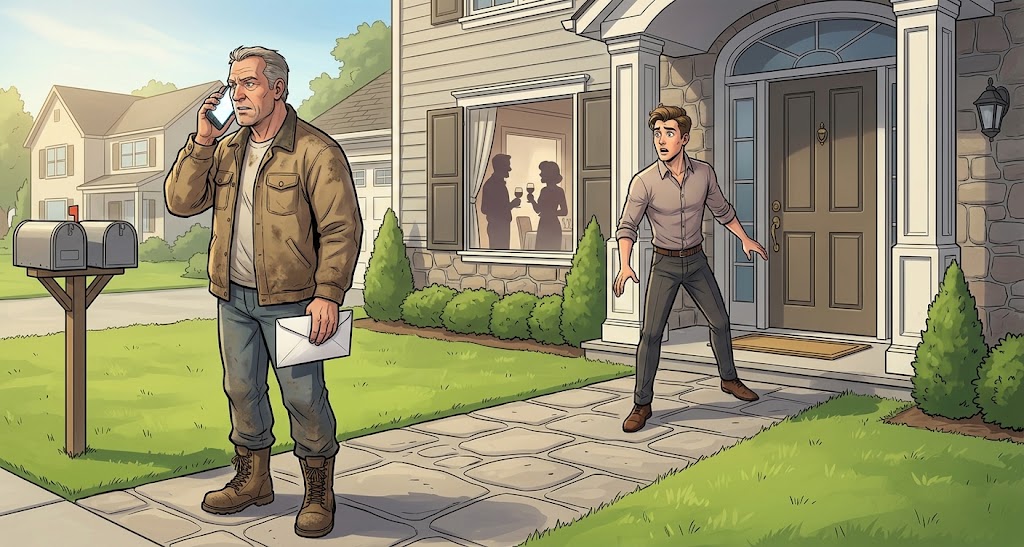
My son spread both arms across the doorway and told me I needed to go back to my truck before his wife’s parents saw me. I was still wearing my old canvas work jacket, the one with the dark roof-sealant stain on the left sleeve that never came out in the wash. I had spent the morning checking a commercial roofing project across town, walking a half-finished warehouse roof with a superintendent half my age who still called me Mr. Dillard even though I had sold my company years earlier. There was chalk dust on my jeans, grit on my boots, and the faint smell of hot asphalt clinging to the jacket. I knew exactly what I looked like. My son, Trent, knew too. He stood in front of me in a pressed linen shirt, fitted trousers, and leather loafers polished so carefully they reflected the afternoon light from the porch. His eyes moved from my boots to my sleeve, then toward the dining-room window behind him.
“Dad, please,” he said. “Not today.” I had driven across town to hand him an envelope. That was all. Updated insurance documents for the Brentwood house, signed and copied by my attorney, Calder Webb. Trent had known I was coming. I had called him that morning, and he had told me three o’clock was fine. Now he was standing in the doorway of a house I owned, acting as though I were a delivery driver who had wandered onto the wrong porch. I lifted the envelope slightly. “Thirty seconds. I’ll hand you this, say hello, and be gone.” His shoulders tightened. “You can’t come in looking like that.” I looked at him for several seconds. I did not raise my voice. I did not ask him what he meant. I already knew. Somewhere inside the house, a man laughed. I recognized the voice immediately. Gareth Bellamy, Trent’s father-in-law, had driven up from Savannah with his wife, Eloise. Trent had mentioned their visit when I called, but he had not said it was a formal lunch or that he apparently needed the afternoon arranged like a stage set.
Trent lowered his voice. “They have a certain idea about us. About me. I’ve spent years building that relationship. I don’t need them seeing you walk in like you just came off a job site.” There are sentences that hurt because they are cruel. There are others that hurt because they explain things you have been refusing to understand. Trent’s sentence belonged to the second kind. I did not answer right away. I watched him standing there, one hand still resting against the doorframe, the expensive watch I had given him for his thirtieth birthday visible beneath his cuff. Then Gareth’s voice carried through the open side window. “You have to give Trent credit,” he was saying. “Buying in Brentwood when he did was smart. Property like this only gets harder to find.” Eloise said something I could not make out. Then Gareth continued. “Madison deserved a home like this. Trent understood that. A man reaches a certain age and he ought to have something substantial to show for himself.”
Trent stopped moving. I looked at him. He looked at me. And suddenly the five years behind us rearranged themselves in my head. The dinners where Gareth had complimented Trent’s “real-estate instincts.” The Christmas when Eloise had asked me, in that careful voice of hers, whether I was “still doing little roofing projects to keep busy.” The neighborhood barbecue where Madison introduced me to someone as “Trent’s dad, retired construction” while Trent quietly changed the subject when the man asked who had found the Brentwood property. I had noticed those moments. I had simply chosen not to connect them. Until then. “They think you bought this house,” I said. Trent looked toward the window again. “Dad, it’s complicated.” “No,” I said. “It’s actually very simple. Do they think you bought this house?” He rubbed his thumb along the side of the doorframe. It was a habit he had had since childhood whenever he was trapped between the truth and the answer he wanted to give.
“I never exactly said it like that.” That was answer enough. I reached into the front pocket of my jeans and pulled out my phone. Trent’s face changed immediately. “What are you doing?” I scrolled to Calder Webb’s name. I had not called him in several months because there had been nothing to call about. Calder handled my estate documents, property records, and the pieces of financial life I preferred to keep boring. “Dad, wait.” I pressed the call button and put the phone on speaker. The line rang twice. “Kent,” Calder answered. “Everything all right?” I kept my eyes on Trent. “I’m standing at the Brentwood property,” I said. “I need you to begin reviewing how to end Trent’s occupancy and prepare the property for transfer. I also want a full title review before anything moves.” The color left Trent’s face. “Dad.” Calder did not react to Trent’s voice in the background. “Is this a final instruction or are you asking me to outline options?”
“Final.” There was a short pause. “Understood,” Calder said. “I’ll start with the title and occupancy file. I’ll call you in the morning.” I ended the call. Trent stared at me as though I had suddenly become someone he had never met. Maybe I had. My name is Kent Dillard. I am sixty-three years old, and for most of my adult life I built roofs and waterproofed commercial buildings from Nashville to Knoxville. I started with one pickup truck, two ladders, a used tar kettle, and a business card Barbara designed at our kitchen table. Over forty years, that turned into a commercial company with multiple crews, repeat contracts, and enough work that I eventually learned to spend more time reading estimates than carrying material.
I sold the company eight years ago. I had been careful with money long before I ever had much of it, and selling the business did not change that. I still drove a 2008 GMC Sierra because it started every morning. I still clipped grocery coupons because saving three dollars on coffee did not become foolish just because I could afford not to. I still wore old work jackets because a stain did not make a jacket useless. Barbara used to tease me about it. “You could walk into a bank with enough money to buy the building,” she once told me, “and they’d still ask if you’re there to fix the gutters.” I told her that was fine with me. Roofs had paid for everything we owned.
Barbara passed away six years before that afternoon in Brentwood. Her final year had been long and difficult, and when the house became quiet afterward, I learned how much of a marriage is made from small noises. A cabinet closing in the kitchen. The dryer buzzing. Someone humming from another room. A second coffee mug in the sink. When those noises disappear, the rooms do not just become silent. They become oversized. Trent was thirty-one when we lost her. He had married Madison the year before. At the time, I believed grief might bring us closer. For several months it did. He called more often. He stopped by on Sundays. Once, after helping me stack some boxes in the garage, he stood there holding one of Barbara’s old gardening gloves and cried so hard he had to sit down on the tailgate of my truck. I remember putting a hand on the back of his neck and thinking, He is still my boy.
That thought made it easy to help him later. About a year after Barbara was gone, Trent came to me with what he called a temporary problem. He and Madison were renting an apartment in East Nashville. Their rent had gone up sharply, their lease was ending, and they had not saved enough for the kind of home Madison wanted. We sat at my kitchen table. Trent had a legal pad in front of him with numbers written in neat columns. He had an accounting degree and a mind that liked spreadsheets. He explained their income, their monthly expenses, and what he thought they could save if they had two or three years without rent. I already owned a house in Brentwood. I had bought it three years earlier as an investment for $780,000 in cash. The tenants were moving out at the end of that same month. It was one of those situations that seems obvious when you are a father looking at your only son across a kitchen table.
“Live there,” I told him. “No rent. Two or three years. Save what you’d be paying a landlord. Build a down payment. Then buy something that’s yours.” He stared at me. “You’re serious?” “I’m not handing you the house,” I said. “I’m giving you room to get steady. There’s a difference.” He got up, walked around the table, and hugged me. I can still remember the pressure of that hug.
For the first year, things went exactly as I expected. Trent sent me photos when he and Madison repainted the guest room. He asked before replacing light fixtures. He texted me when the dishwasher started making noise. I paid the property taxes, the homeowner association fees, major maintenance, and the annual HVAC service. They handled utilities, yard basics, and ordinary day-to-day upkeep. Then the second year became the third. The third became the fourth. At first I did not push. Housing prices had climbed. Interest rates moved. Trent said they were building savings. Madison had changed jobs twice. Life happened. I had enough money, and the house was appreciating. I told myself there was no harm in patience. But small things began to change. Trent stopped asking before making cosmetic changes. A contractor called me once to verify whether I had approved a built-in wine wall in the dining room. I had not. I told the contractor that if Trent was paying for it himself and it did not alter the structure, I did not care. The contractor sounded embarrassed for asking.
At Thanksgiving, Eloise complimented Madison on “what you’ve done with your property.” I noticed the wording. Trent immediately asked me about my truck before I could respond. Another time, Gareth stood in the driveway with me and said, “Trent made a strong decision getting into this neighborhood early.” I could have corrected him. I did not. That silence belonged to me. I told myself I was avoiding an awkward conversation. I told myself Gareth was probably speaking generally. I told myself Trent would explain things in his own time. The truth was simpler: I did not want to embarrass my son in front of his wife’s family. That was the irony of the thing. I had been protecting him from embarrassment while he was quietly turning me into the embarrassment. Gareth and Eloise Bellamy were not cruel people in the dramatic way stories sometimes make wealthy people cruel. They were polished. That was different. Their judgment came wrapped in compliments, questions, and tiny pauses.
Gareth had spent more than thirty years in luxury interior design. He could talk for twenty minutes about Italian marble without noticing whether anyone else wanted to hear it. Eloise sat on charity boards, remembered everyone’s school history, and could tell the difference between two wine regions by smell. Their Savannah house had framed family portraits in a hallway and a dining room where nothing ever seemed out of place. I did not dislike them. I simply never felt relaxed around them. At our first Thanksgiving together, Gareth asked what kind of roofing I had done. When I told him commercial waterproofing, he said, “Ah, practical work,” in the same tone a person might use for a reliable lawn mower. Barbara, had she been alive, would have kicked me under the table before I could answer. So I smiled and passed the potatoes. Trent noticed all of it. I know that now.
As a child, he had never cared what I wore. When he was nine, he followed me around on Saturday mornings in an oversized hard hat, handing me nails one at a time like each one was important. When he was fifteen, he begged to work a summer with one of my crews. I made him start by sweeping the yard, because I did not want the men thinking the owner’s kid got special treatment. By the end of August, he had learned how to read basic plans and how to roll membrane straight without trapping air. He hated the heat. He loved the paycheck. I paid for his college because Barbara and I had planned for it. I bought him a used truck when he was seventeen. When he got his first professional job, I gave him the watch he wore on the Brentwood porch. I was proud of him not because he became an accountant instead of a contractor, but because I thought he understood the same lesson my father taught me: your name should mean something when it is attached to a promise.
Standing on that porch, I realized he had learned a different lesson somewhere along the way. He had learned that appearances could be treated like assets. After I ended the call with Calder, Trent stepped toward me. “You can’t do this because of one awkward conversation.” I put the phone back in my pocket. “This isn’t about one conversation.” “You don’t understand how Gareth is. He judges everything. Madison has spent years trying to get out from under that. I was trying to protect her.” “By pretending you bought my house?” “I didn’t pretend. I just didn’t explain every detail.” “You let them believe it.” “What’s the difference?” That question surprised me more than anything else he had said. I looked past him through the narrow opening of the door. I could see the edge of the dining room, white flowers on the table, glassware catching the light, a tray on the sideboard. Someone had put considerable effort into making the afternoon look effortless.
“The difference,” I said, “is that you knew the truth would change how they saw you. So you changed the truth instead.” His face hardened. “You always make everything about some old-school principle.” “And you always call a principle old-fashioned when it gets in your way.” The door moved behind him. Madison appeared for half a second, then stopped when she saw me. Her expression changed from surprise to alarm. “Kent?” she said. Trent turned sharply. “Go back inside. I’ll handle it.” I noticed the sentence. Not I’ll explain it. I’ll handle it. Madison looked from Trent to me, then to the envelope in my hand. “Is everything okay?” “Ask your husband,” I said. I placed the insurance envelope on the porch table instead of the mailbox. Then I walked down the steps. Trent followed me halfway across the lawn. “Dad, don’t turn this into something bigger than it is.”
I kept walking. “We are family,” he called. “You don’t do this to family.” I stopped beside my truck and turned around. “You’re right,” I said. “You don’t.” Then I got in and drove away. I took the long route home, not because I wanted scenery but because I did not trust myself to think clearly in traffic. The interstate was crowded, so I stayed on surface roads through neighborhoods where new construction stood beside old ranch houses. My phone buzzed three times in the cup holder. Trent. Then Madison. Then Trent again. I let all three calls go unanswered. Anger was there, of course, but it was not the strongest thing I felt. The stronger feeling was humiliation, and I resented it. I had spent my life doing work some people considered dirty so they could sit dry inside clean buildings. I had never once been ashamed of that. Yet my own son had managed, in less than five minutes, to make me feel as though I had shown up somewhere I did not belong.
At a red light, I looked down at my hands on the steering wheel. The knuckles were thick from age and years of work. There was a pale scar across one thumb from a sheet-metal edge decades earlier. Barbara used to call them honest hands. I remembered something she had said when Trent was young. “Be careful helping him too much,” she told me after I paid for a summer program he wanted. “You can remove every obstacle and accidentally remove the lesson too.” I had laughed. “He’s seventeen. He’ll find more obstacles.” She did not laugh back. That memory stayed with me all the way home.
I made coffee even though it was after five. I sat at the kitchen table with my phone face down and listened to the creek behind the house. Trent sent seven messages before nine that night. The first two were angry. The third was defensive. The fourth blamed Gareth. The fifth blamed Madison. The sixth said I had misunderstood. The seventh simply said, Please don’t do anything permanent until we talk. I did not reply.
At 8:45 the next morning, Calder called. I knew from his voice that the problem had changed. “Kent,” he said, “I need you to sit down if you’re not already.” I was standing at the kitchen counter. I pulled out a chair. “Go ahead.” “The title review found an active home-equity line attached to the Brentwood property. It was opened twenty-two months ago. Current balance is essentially the full limit. One hundred thirty thousand dollars.” For a moment, the number did not make sense. “I don’t have a line on that house.” “I know.” “I paid cash.” “I know that too.” I stared at the wood grain of the table. Calder continued carefully. “The account file uses your identifying information and appears to contain an electronic signature in your name. I have requested the complete authorization record. I am not making conclusions until we see the documents, but I need you to tell me plainly: did you ever approve a home-equity line connected to Brentwood?”
“No.” “Did you ever authorize Trent to apply for one on your behalf?” “No.” “Did you ever discuss using that property as collateral for a loan?” “No.” There was silence on the line. “All right,” Calder said. “Then we treat this as an unauthorized financial matter and move very carefully. Do not discuss details by text with Trent. Do not send accusations. Do not sign anything he gives you. Come to my office this afternoon.” I ended the call and stayed at the table. The creek moved outside the window. A blue jay landed on the fence, hopped twice, and flew away. Ordinary things continued with insulting normality. One hundred thirty thousand dollars. I thought about every time Trent had been in that kitchen during tax season. He had an accounting background, and for the previous three years he had offered to help organize my records. I had appreciated it. I still used paper files for more things than he considered reasonable. He teased me about the filing cabinet in my study.
“Dad, half this stuff can be scanned.” “Paper doesn’t forget a password.” “Paper also burns.” “Then I’ll buy a fireproof cabinet.” I had trusted him enough to hand over folders containing bank statements, tax documents, property records, and identification information. I had made coffee while he sorted them. I had left him alone in the study while I went to the hardware store. Once, I had given him the key to the cabinet because I had a dentist appointment and he wanted to finish before driving home. At the time, none of it had felt reckless. It had felt like letting my son help his father.
By noon, that memory no longer felt the same. Calder’s office occupied the second floor of an older brick building downtown. His receptionist had known me for years and normally asked about fishing. That afternoon she simply said, “He’s waiting for you,” and opened the conference-room door. A stack of printed pages sat on the table. Calder was sixty, lean, silver-haired, and incapable of wasting a sentence. He pointed to the chair across from him. “The bank sent preliminary records faster than expected.” I sat down. He slid the first page toward me. It showed the line of credit, the property address, and my name. The next page showed contact information. My home address. My date of birth. The last digits of identification numbers. An email address I did not recognize. Then came the signature page. My name was there in neat electronic script. It was not my signature. I did not feel dramatic anger. I felt cold.
“Where did the money go?” I asked. Calder slid another sheet across the table. “Most of it moved out in a series of transfers over approximately six weeks. The receiving account belongs to Bellamy House Studio LLC, Savannah, Georgia.” I read the name twice. Gareth and Eloise’s design company. I leaned back. “How much?” “Just under the full amount, after fees and a small reserve.” “And you’re certain that’s their company?” “State business records confirm it.” I looked at the papers again. Calder continued. “I’ve also reviewed publicly available filings connected to the company. They’ve had financial pressure for several years. A major client dispute, unpaid vendor claims, and a restructuring attempt. I’m not telling you why the transfer happened. I’m telling you where the account leads.” I nodded. “What happens now?” “First, we protect you. The bank gets a formal dispute. We lock down your credit profile. We review every property you own for anything else you didn’t authorize. We change access credentials. We document Trent’s prior access to your records. Then we let the bank’s compliance people and the appropriate financial authorities determine what happened.”
I looked up. “And the house?” “The line complicates a transfer, but not permanently. We can resolve the balance and clear the title if you choose.” “One hundred thirty thousand dollars.” “Yes.” “Money tied to my house, using my information, and sent to his in-laws.” Calder folded his hands. “Based on the records in front of us, that is the path.” I sat there for a long time. Then I asked the question I had been avoiding. “Can Trent explain this in some innocent way?” Calder’s face did not change. “I hope he can. But hope is not a financial control.” That sentence stayed with me.
We spent nearly three hours reviewing accounts. Calder called my bank while I sat there. We changed passwords. We added verification requirements. We placed alerts on my credit profile. His assistant created a list of every property and business entity connected to my name so they could be checked individually. The work was boring, methodical, and strangely calming. For most of my life, when something went wrong on a roof, panic made the problem worse. A leak did not care how angry you were. You found the entry point. You traced the water path. You opened what needed to be opened. You replaced what had failed. Then you tested it. By four o’clock, I had stopped thinking like an offended father. I had started thinking like a man inspecting damage. And damage, once you see its boundaries clearly, becomes something you can address.
That evening, Trent came to my house without calling first.
I heard the back gate before I heard his knock. He had used that gate since he was a teenager, when he would come home late and try to avoid the loose front step that creaked. For a strange second, hearing the latch click took me backward twenty-five years. Then he appeared through the kitchen door, and the feeling disappeared. He looked tired but not apologetic. There was a difference. His shirt was wrinkled. His hair, usually carefully fixed, had been pushed back with both hands so many times that it stood unevenly near the crown. “We need to talk,” he said. “Sit down.” He took the chair across from me, the same chair he had used years earlier when he asked to live in the Brentwood house. He started with confidence. “The bank situation isn’t what you think.” I waited. “We discussed using the equity. Two tax seasons ago. I explained that keeping all your value locked in property wasn’t efficient. We talked about a line as a portfolio tool.”
I said nothing. He leaned forward. “You agreed it was worth exploring.” Still I said nothing. People reveal a surprising amount when silence makes them uncomfortable. Trent kept going. “I know you don’t remember every financial conversation we have. That’s normal. You have a lot of accounts. A lot of properties. I handle numbers every day. You don’t.” There it was. Not an apology. Not confusion. A new version of me. In his version, I was old enough to forget important decisions, unsophisticated enough to need him, and uncertain enough to accept his explanation if he repeated it confidently. “My memory is fine,” I said. “I’m not saying it isn’t.” “You just did.” “That’s not what I meant.” “Then say what you mean.” His mouth tightened. “I mean we talked about leverage. You were open to it.” “Did I sign that application?” He looked away. “It was electronic.” “That isn’t an answer.”
“You told me to handle things.” “Did I sign it?” He pushed back from the table and stood, then immediately sat again. “Dad, the money wasn’t wasted. Gareth’s company was in a temporary cash squeeze. They had receivables coming. There was a project delayed. It was supposed to bridge them for a few months.” The story had changed in less than five minutes. First I had approved a financial strategy. Now the money had been used to rescue his in-laws’ business. “Why wasn’t I told?” “Because you already don’t like them.” “That did not answer my question.” “Because you would have said no.” The room went quiet. I watched him realize what he had admitted. He looked down at his hands. “You don’t understand the pressure Madison was under.” “Then explain it.” He did.
For the next twenty minutes, my son described a world where every bad decision had been made necessary by someone else’s expectations. Gareth expected Trent to be successful. Eloise expected Madison to live at a certain level. Madison expected Trent to protect her from embarrassment. Their friends expected vacations, dinners, memberships, clothes, homes that looked a certain way in photographs. The Bellamy business had struggled, but they could not let clients know. A visible financial setback, Trent said, would have damaged the brand. I listened until he ran out of reasons. “So you used my house to support their image,” I said. “I used available equity to help family through a temporary period.” “Without asking me.” “I knew what you’d say.” “Exactly.” He stood again. “You act like this is some enormous betrayal. You’ve got more money than you’ll ever spend. One hundred thirty thousand dollars doesn’t change your life.”
That sentence landed harder than the number itself. I had heard versions of it from people before. A subcontractor once padded an invoice and later told me the extra amount was insignificant compared with the size of the project. An employee years ago had used a company vehicle for months of personal errands and said the fuel cost was nothing to a business my size. They had both missed the point. The size of the loss does not determine the size of the permission. “You don’t get to decide what matters to me based on what you think I can afford,” I said. Trent looked at the window. It was dark outside now, and the glass reflected both of us back into the room. “If you push this,” he said, “you’re going to destroy this family.” “No.” “You are. Madison is already talking about leaving if her parents get dragged through a financial review. Gareth is furious. Eloise is a wreck.”
“And what are you?” He stared at me. “I’m trying to stop you from making a decision you’ll regret.” “I made my decision yesterday.” Then he used the one thing he apparently thought would still move me. He said he and Madison had been talking about having children. He said if I kept going, I should not expect to be part of those children’s lives. He said there would be no birthdays, no holidays, no weekends at my house. He said I would be choosing paperwork over family. I had imagined grandchildren before. Barbara and I used to joke about what kind of grandfather I would be. She said I would buy a child one toy and then build a shed to store it. I said she would spoil them until they were impossible. The thought of never meeting those children, if they ever came, hurt. But the way Trent used them hurt more.
He was offering me a future relationship in exchange for silence about a present wrong. Something inside me became very clear. I stood. “The conversation is over.” “Dad—” I walked to the front door and opened it. “Calder will contact you. From now on, anything involving the house or the bank goes through him.” Trent did not move. “You’re serious?” “Yes.” “You’re really going to throw away your own son over money?” I looked at him for a long moment. “No. I’m refusing to let my son use family as a reason I should ignore what he did. Those are not the same thing.” He left without saying goodbye. I watched his taillights disappear down the road, then locked the door and went back to the kitchen. For the first time since Barbara had passed, the empty house did not feel empty. It felt peaceful.
The next morning, Calder called before nine. “How certain are you about transferring Brentwood?” “Completely.” “Then we need a clean title. The fastest route is to satisfy the line, preserve your dispute rights, and pursue recovery separately.” “Do it.” He paused. “Kent, that’s one hundred thirty thousand dollars out of your liquid funds. I need you to understand that clearing it does not mean you are accepting responsibility for how it was opened. We will document everything.” “I understand.” “I also don’t want you making the decision just because you’re angry.” “I’m not angry this morning.” That was true. Anger had burned down into something more useful. “What are you planning to do with the property?” he asked. I looked out toward the creek. “I don’t know yet. But Trent isn’t staying there.”
After we hung up, I drove to Brentwood without telling anyone. I did not go to the house. I parked two streets away near a small neighborhood park and walked for nearly an hour. The neighborhood was the kind of place real-estate brochures describe with words like established and desirable. Mature trees. Wide sidewalks. Carefully maintained lawns. Children riding scooters after school. Retired couples walking dogs that looked better groomed than I ever had. I had bought the house because I thought it was a safe investment. Now I tried to think of it without Trent in the picture. What was it, really? Five bedrooms. Four and a half bathrooms. A broad kitchen. A finished lower level. A fenced yard. Good schools nearby. Access to hospitals, stores, and public services. More space than one couple needed.
Years earlier, through my old company, I had donated occasionally to a Middle Tennessee organization called Cornerstone Transition Network. They helped former service members and their families stabilize after housing disruption, job changes, or difficult transitions back into ordinary civilian routines. They were practical people. They helped with temporary housing, job placement, transportation, and school enrollment. No speeches. No glossy galas. Just steady work. I remembered a conversation with their director, Nathan Cole, at a fundraising breakfast the previous year. He had mentioned that larger homes were difficult for them to secure. They wanted places where more than one family could stay temporarily without being placed in a motel environment. I called him from the park bench. “Nathan, this is Kent Dillard.” “Kent. Good to hear from you.” “You still looking for a larger residential property south of Nashville?” There was a pause. “Always. Why?” “I may have one.” He laughed once, thinking I was probably offering a lead.
“Send me the listing.” “It isn’t listed.” Another pause. “What exactly are you saying?” “I’m saying I own a house in Brentwood. Five bedrooms. Finished lower level. Large yard. No mortgage once I clear one title issue. I want to know whether your organization could use it.” He was silent long enough that I thought the call had dropped. “Kent, are you talking about a lease?” “I’m talking about ownership.” His voice changed. “I think we should meet.” We met the next day at a diner off Franklin Road. Nathan brought the organization’s operations manager and a folder full of numbers even though I had not asked for them. That told me I had called the right people. They did not sell me a dream. They told me the complications first. The property would need code review for their intended use. Some rooms might need modifications. Parking could become a neighborhood concern. They would need insurance changes. There could be zoning questions depending on how many people stayed at once. They would not accept the house if the ongoing cost made it unsustainable.
I appreciated every objection. “Good,” I said. “I don’t want gratitude. I want a plan.” Nathan smiled. “You really did own a roofing company.” “For forty years. If someone starts by telling me nothing can go wrong, I stop listening.” They agreed to inspect the property as soon as it was legally available. Calder cleared the line three business days later using funds from my account, while preserving the formal dispute and every document connected to the unauthorized application. Seeing the transfer confirmation still bothered me. One hundred thirty thousand dollars represented years of work, even if I could absorb it. I remembered summers when my crews started before sunrise because the afternoon roof temperature became unbearable. I remembered winters when sealant stiffened in the tube and men warmed their gloves on truck vents. I remembered bidding jobs at my kitchen table after Trent went to bed because I could not afford office staff yet.
Money was never just numbers to me. It was time converted into something measurable. That made what Trent had done worse, not because I worshipped money, but because he had treated forty years of my time like an available resource he did not need permission to use. The day the title cleared, Calder called me. “We can transfer now.” “Prepare it.” “To Cornerstone?” “Yes.” “Full donation?” “Full donation.” He exhaled softly. “That’s a substantial gift.” “So was five years of free housing. One of them produced gratitude. The other produced entitlement. I’m adjusting my strategy.” Calder actually laughed.
That Friday, I signed the transfer documents in his conference room. The act itself was almost boring. Initial here. Sign there. Confirm legal description. Review tax language. Sign another page. A house that had become the center of my family’s argument moved from one column to another through ink and paper. But when I put down the pen, I felt lighter. “Once recorded,” Calder said, “Cornerstone becomes the owner. Trent’s occupancy issue will be theirs to handle with our coordination.” “I want it handled correctly. No shortcuts.” “It will be.” “And no public mention of my name.” He looked at me. “Cornerstone may want to recognize the donor.” “They can recognize the house. Leave me out of it.” He nodded.
That afternoon, I called Nathan. “It’s done.” He did not answer for a moment. “Kent, I don’t know what to say.” “Say you’ll use it well.” “We will.” “Then we’re finished.” We were not finished, of course. Trent learned about the transfer the following Monday. He called Calder first. Then he called me eleven times. I answered the twelfth. “What did you do?” His voice was so loud I moved the phone away from my ear. “I transferred my property.” “To some organization?” “Yes.” “You gave away the house?” “Yes.” “You gave away a million-dollar house because you were mad at me?” “No. I gave away a house because I no longer wanted it supporting a situation that was bad for everyone involved.” “We live here.” “Temporarily. That was always the arrangement.” “For five years!” “Which is three years longer than the first conversation.” “We improved this place.” “You decorated it.”
“We put money into it.” “Then send Calder your documented capital improvements. He’ll review them.” Silence. I knew there would not be many. I had paid for the major work: HVAC repair, roof maintenance, drainage improvements, property taxes, association dues, and several appliance replacements. Trent and Madison had paid for paint, furniture, fixtures, and design choices that mostly left with them. “Madison is falling apart,” he said. “I’m sorry she’s upset.” “Her parents are still here. Do you have any idea what this looks like?” There it was again. Not what it is. What it looks like. “I think that’s been the problem for a long time,” I said. He hung up. Cornerstone’s attorneys delivered formal occupancy notices according to the required process. No dramatic confrontation occurred. No one showed up making a scene. There were letters, deadlines, phone calls, and lawyers doing what lawyers do.
Trent hired his own attorney and argued that five years of occupancy created special rights. His attorney referenced verbal understandings, maintenance contributions, and family expectations. Calder responded with the original written property file, tax records, insurance records, my payment history, and messages in which Trent himself had repeatedly referred to the arrangement as temporary. One old message mattered more than I expected. Three years earlier, Trent had texted me after I paid for a new HVAC compressor. Thanks, Dad. I know it’s still your house and you don’t have to keep covering this stuff. We appreciate it. Calder printed that line on a separate page. “People forget that phones keep receipts,” he said. I thought about the porch conversation. Trent had not forgotten the house was mine. He had simply built a different story for a different audience. Nathan asked whether Cornerstone could begin preparing the property for its intended use as soon as it became vacant. I told him yes. Their team scheduled inspections. They spoke with local service providers. They planned bedroom assignments, safety upgrades, storage, and transportation needs.
For the first time, I began to imagine the house without the expensive dining table, the staged entryway, or the Bellamys’ assumptions attached to it. I imagined children doing homework at the kitchen island. I imagined a father starting a new job and coming home tired to a place where the utilities were already on. I imagined a mother opening a bedroom door and realizing her family would not have to move again the next week. A house is just walls until it is useful to someone. That thought mattered to me. The bank review moved quietly in the background. Calder handled most of the communication. The account records showed that the application had been submitted from a computer outside my home, using information only someone with access to my records would likely have known. The contact email had been created shortly before the application. Verification messages had gone to a phone number that was not mine.
The transfer history was even clearer. Funds had moved from the line to an intermediary account and then to Bellamy House Studio in several installments. Calder showed me the sequence on a timeline. “This is why you don’t need to argue with Trent about what happened,” he said. “The records are going to speak for themselves.” I liked that. Records did not get emotional. They did not change stories. They did not say you had misunderstood their tone. They simply stayed where you put them.
A week after the transfer, Madison called me directly. It was the first private conversation we had ever had that lasted more than five minutes. Her voice was controlled at first. “Kent, I know you’re angry with Trent.” “This is not just anger.” “Whatever you want to call it, the house situation is punishing me too.” “The house was never promised to either of you permanently.” “But we built a life here.” “You lived there without rent for five years. That was supposed to help you build the next part of your life.” She was quiet. “Trent said you always intended to give it to us eventually.” I closed my eyes. “I never said that.” “Not once?” “Not once.” Another silence. “He told me after the second year that you had basically already decided it would be part of his inheritance.” “That’s not true.” Her breathing changed. I did not enjoy the moment. I did not feel vindicated. I felt tired.
“Did you know about the line of credit?” I asked. She answered too quickly. “No.” Then she corrected herself. “I knew there was financing. I didn’t know how he got it. Trent told me it was arranged through family assets and that you had approved a temporary structure.” “Did your parents know?” “They knew money was coming into the business.” “Did they think it came from me?” She started crying quietly. I waited. “I don’t know what they thought,” she said. “At this point, I don’t know what anyone thought.” That was the first honest thing I had heard from inside that house in weeks. “Madison,” I said, “I’m not asking you to choose between your husband and me. I’m asking you to stop relying on what other people say I agreed to. If my name is attached to something, ask me.” She whispered, “I should have.” When the call ended, I sat with the phone in my hand and felt no satisfaction at all.
Consequences are clean in stories when you summarize them. In real life, they spread into people who were careless, people who were proud, people who were misled, and people who should have asked more questions. I had no interest in making Madison suffer. But I was no longer willing to make myself responsible for preventing every uncomfortable result of choices I had not made.
The move-out deadline became the next pressure point. For years, Trent had lived as though the Brentwood house were fixed beneath him. Now every room had to be reconsidered. Furniture had to be sorted. Storage had to be found. An address that had appeared on holiday cards, business forms, social invitations, and carefully framed photographs was becoming temporary in a way it had always technically been. Trent responded first by bargaining. Through his attorney, he offered to begin paying rent. I declined. Then he offered to buy the house over time.
I declined because the house was no longer mine. Then he proposed that Cornerstone lease it back to him for twelve months while he “stabilized.” Nathan politely declined because the organization already had families waiting for housing. Then Trent called me again. “Do you even care where we go?” “I care that you find somewhere safe and appropriate. You’re both employed. You have options.” “Not in Brentwood on short notice.” “Then you may not live in Brentwood.” He made a sound of disbelief. That sentence, more than anything else, seemed to reveal how far his expectations had moved. To Trent, leaving Brentwood did not feel like a normal housing adjustment. It felt like a fall in status. I remembered the East Nashville apartment he and Madison had once considered perfectly respectable. I remembered the gratitude on his face when I first handed him the keys. Somewhere across five rent-free years, temporary help had become a baseline, and the baseline had become a right.
A few days later, Gareth called me. I almost did not answer. Then I decided I wanted to hear what he had to say without Trent translating either side. “Kent,” he began, formal as always. “I think the families need to have a civilized conversation.” “We’re having one now.” He cleared his throat. “This situation has escalated far beyond what anyone intended.” “I agree with that.” “Trent made errors in judgment. No one is denying that.” It was the first time I had heard anyone on that side use even that much direct language. “What are you asking for?” I said. “Time. Discretion. A chance to resolve the financial issue privately. My company can repay the amount over a reasonable schedule.” “The bank review is already underway.” “Reviews can be closed.” “Not by pretending the problem never existed.” His voice cooled. “You and I come from different worlds, Kent. In business, sometimes complex arrangements are made informally among people who trust one another.”
I actually smiled. “Gareth, I spent forty years in construction. If you think my world runs on casual trust without paperwork, you’ve never met a contractor.” He did not answer. “My name was used on an account I did not approve,” I continued. “Money connected to my property ended up in your company. If there is an innocent explanation, provide it to the people reviewing the records.” “This does not need to become public.” “I never asked for it to become public.” “But your property transfer makes everything visible.” There it was. The same fear again. Appearance. “That transfer is separate,” I said. “I decided I wanted the house used for something worthwhile.” “At the expense of your son.” “No. My son had five years of help. Other people can use some now.” Gareth’s tone changed from polished to sharp. “You are making a very expensive point.” “It’s my expense.”
He had no answer to that. The call ended with neither of us satisfied, which was fine. Not every conversation needs agreement. Sometimes it only needs clarity. Two days later, Eloise sent me a handwritten letter by overnight mail. That was exactly the sort of thing Eloise would do. Even crisis arrived on heavy cream paper. She wrote that she had always respected my independence, that there had been misunderstandings on all sides, and that the Bellamy family valued privacy above spectacle. She said Madison was devastated and asked me to remember that young marriages were fragile under outside pressure. I read the letter twice. Then I placed it in the folder Calder had told me to keep. I did not respond.
The final week before Trent and Madison left the house was the most emotionally difficult period, not because anything dramatic happened, but because ordinary family memories kept colliding with legal logistics. Trent sent me a photograph of himself at age ten sitting on my shoulders at a county fair. No message. Just the picture. The next day, he sent a photo of Barbara holding him at his college graduation. Again, no message. On the third day, he wrote, Mom would hate what you’re doing. I stared at that sentence for a long time. Then I typed a response and deleted it. I typed another and deleted that too. Finally I wrote: Your mother valued kindness. She also valued honesty. Please do not use her memory to avoid this conversation. He did not reply. That night, I went to the hall closet and opened a plastic storage bin I had not touched in years. Inside were family photographs, school programs, old birthday cards, and one envelope containing notes Barbara had written to herself during her final months. Most were ordinary reminders: call insurance, ask Kent about garden, Trent dinner Sunday.
One note stopped me. It said: Kent worries love means never saying no. I sat on the floor with that scrap of paper in my hand. Barbara had always seen through me faster than I saw through myself. I had spent years believing generosity was safest when it asked for nothing back. That sounded noble, but it carried a hidden weakness. If you never state the limit, other people can start believing there is no limit. I had not caused Trent’s choices. But I had made it easy for him to confuse support with entitlement because I avoided uncomfortable boundaries until the situation became impossible to ignore. That realization did not excuse him. It simply gave me something useful to learn.
The day before the move-out deadline, I drove past the Brentwood property at Nathan’s request. Cornerstone wanted to inspect the exterior and verify access points after the house was vacant. I stayed in my truck across the street while two staff members walked the sidewalk and took notes. A moving company had parked in the driveway. Boxes filled the garage. Madison stood near the open door in leggings and a gray sweatshirt, talking to a mover. She looked smaller somehow without the polished setting around her. Trent came outside carrying a framed photograph. He saw my truck. For several seconds, neither of us moved. Then he walked across the lawn. I rolled down the window. He stopped three feet away. “Come to watch?” “No. Cornerstone needed exterior access.” He looked toward Nathan’s staff. “You really gave it away.” “Yes.” “I thought you’d change your mind.” “I know.” That answer bothered him.
“You always change your mind with me.” I looked at him. There are moments when someone accidentally tells you the whole history of a relationship in one sentence. “That’s probably part of how we got here,” I said. He looked down at the frame in his hands. It was a photograph of him and Barbara from his wedding day. “I don’t know where we’re going yet,” he said. “Your attorney said you signed a short-term rental in Franklin.” He looked surprised. “Calder told you?” “He told me you had secured housing. That’s all I needed to know.” Trent nodded once. “Madison says she may go to Savannah for a while.” “I’m sorry to hear that.” “Are you?” “Yes.” He studied my face as though looking for mockery. There was none. “I don’t understand you,” he said. “You used to.” He flinched slightly. I regretted the sharpness as soon as I said it, but I did not take it back.
“I keep thinking,” he said, “if you’d just talked to me before calling Calder, maybe we could have fixed it.” “I did talk to you. On the porch. You told me to go back to my truck because I embarrassed you. Then I heard your father-in-law praise you for buying my house.” “That wasn’t about the bank.” “No. It was about the lie that led me to look at the bank.” He had no answer. “Trent,” I said, “I hope you build something of your own after this. I mean that. But I can’t build it for you and then let you tell people you built it yourself.” His eyes filled, but he looked away before anything showed clearly. “I have to get back,” he said. “All right.” He took two steps, then turned. “Did you ever plan to leave me the house?” I considered lying. It would have been kinder in the immediate moment.
But kindness and dishonesty had already become too tangled in our family. “Maybe,” I said. “I hadn’t decided.” His face changed. “So I lost it.” “No. You lost the assumption that it was already yours.” He walked back across the lawn without another word. The next evening, the moving trucks left. Cornerstone took possession after the final walk-through. Nathan called me from the empty kitchen. “There are some wall repairs, paint, a few fixture changes. Nothing major.” “Good.” “You want to come see it before we start?” “No.” “You sure?” I looked around my own kitchen, at the coffee maker Barbara had chosen and the dent in the baseboard from the time Trent crashed a toy truck into it when he was seven. “I already know what that house looks like empty,” I said. “Make it useful.”
Over the next month, Cornerstone did exactly that. They converted one oversized entertainment room into two practical bedrooms with proper egress. They added lockable storage. They replaced a decorative glass door with something safer for children. They simplified the landscaping so maintenance costs stayed reasonable. They installed additional smoke alarms and updated several electrical outlets. Nathan sent me photographs because I had asked to see progress, not ceremony. The most striking change was the dining room. Madison had designed it around a long table under a sculptural light fixture. It had always looked beautiful and formal, like a room waiting for people to behave correctly. Cornerstone replaced the table with two durable rectangular tables that could be pushed together or separated. One photograph showed a stack of donated school supplies at one end and a toolbox at the other. I liked that room more immediately than I ever had before.
Meanwhile, the financial review continued. I tried not to ask Calder for updates every day. He called when something mattered. The bank confirmed that I had not completed the verification steps associated with the line. Device records, contact information, and transfer history did not match my normal account activity. There were enough inconsistencies that the institution formally recognized the matter as disputed and began working through its own recovery process. Separate reviewers requested records from Bellamy House Studio. Gareth’s attorney became the point of contact. Calder told me not to speculate and not to contact them directly. I followed his advice. That was one of the hardest parts. People imagine confrontation as satisfying. Often, restraint is more satisfying because it leaves no new mess to clean up. I did not post anything online. I did not tell neighbors. I did not call relatives to gather allies. I did not send Gareth the bank timeline. I did not forward Eloise’s letter to anyone.
I went fishing twice. I repaired a loose porch board. I helped an old foreman from my company estimate a small church roof because he wanted a second opinion. I bought groceries. I drank coffee by the creek. Ordinary life became a kind of discipline. Then Cornerstone announced its new Brentwood family transition home. They did not name me. They thanked an anonymous donor and explained that the property would support several families at a time during periods of relocation and financial rebuilding. The announcement was positive, but because the property had recently changed occupancy, local reporters asked questions. Public property records showed that the house had been transferred from me to the organization. That was enough for people to connect some dots even without details. A local online article described the house, the donation, and the delay caused by a prior private occupancy dispute. It did not name the prior occupants in the headline, but people who knew the neighborhood understood quickly.
Trent called me that evening. “You said you weren’t making this public.” “I didn’t. Property records are public. Cornerstone announced its own program.” “People know it’s us.” “I can’t control what people know.” “My coworkers have seen it. Madison’s friends have seen it.” “Then tell the truth.” He went quiet. That, I realized, was still the one option he found hardest. “What exactly do you want me to tell them?” “That you lived in a house your father owned. That the arrangement ended. That the house was donated. All of that is true.” “And the bank?” “I didn’t say anything about the bank.” He exhaled slowly. “You make it sound so simple.” “The facts are simple. The consequences are complicated.” He ended the call more quietly than usual.
A few weeks later, Madison moved temporarily to Savannah. Trent stayed in the Franklin rental alone. I knew because he told me, not because Calder did. He called on a Sunday morning. “She left yesterday.” I sat on the back porch with a mug of coffee. “I’m sorry.” “Her parents blame me for everything.” I did not say what came into my head. He continued. “Gareth says I misrepresented what you had agreed to.” That sentence was almost too much. “Did you?” “Dad.” “I’m asking a direct question.” He was silent. “Yes,” he said finally. It was the first clear admission he had made to me. Not about the account. Not about every decision. But about the foundation of the story he had built. “Why?” I asked. He laughed without humor. “Because the first time I met Gareth, he asked what my father did. I told him you owned a roofing company. He asked how big. I said commercial. He asked if you were still in the field. I said sometimes. He looked at me like he had already decided what box to put us in.”
“So?” “So I hated it.” “You hated what?” “Feeling like I came from less.” I looked out at the creek. “You didn’t.” “I know that now.” “No,” I said. “You knew it then. You just wanted him to know it without having to respect the work that produced it.” Silence. Then he said, “Maybe.” That was closer to honesty than we had been in years. “I told him the Brentwood place was ours,” he said. “At first I meant ours like where we lived. Then he assumed I bought it. I didn’t correct him. Later it got harder to correct. Every year made it harder.” “That’s how these things work.” “Then when their business got in trouble, Madison was panicking. Gareth was talking about selling their house. Eloise was calling every day. I thought if I could fix it fast, nobody would ever know.” “So you used my information.” He stopped.
“I thought I could put the money back before it mattered.” There it was. Not a full apology, but the center of the truth. “And when the business didn’t recover?” “I kept waiting.” “For what?” “For something to turn around.” “And if I hadn’t come to the house that afternoon?” He did not answer. I did not need him to. That was perhaps the coldest part of all. The porch argument had felt like the crisis, but it was really an accident that opened a door. If Trent had simply let me inside, smiled, and introduced me as his father, the account might have remained hidden for months longer. His embarrassment had exposed the very thing he was trying to protect. Life can have a brutal sense of symmetry. “I’m not going to ask you to stop the review,” he said. “Good.” “I know you wouldn’t anyway.” “Correct.” “I just wanted you to know I understand more than I did.”
“That’s something.” We ended the call without saying we loved each other. I noticed that. I also noticed that for the first time, neither of us had lied. Months passed. The formal process around the account moved at its own pace. I gave statements, verified records, and provided old signatures for comparison. Trent retained counsel and participated through the proper channels. Gareth and Eloise’s company entered a financial restructuring and later shut down its showroom. Assets were reviewed and obligations sorted out. I was told that a repayment plan and other court-supervised conditions were likely. I did not attend every proceeding. That surprised some people. Calder asked once whether I wanted to be present for a major hearing involving Trent. “Would it change the outcome?” I asked. “No.” “Does he need me there?” “That’s not a legal question.” “Then I won’t pretend it is.” I stayed home.
Later, Calder called and explained that Trent had accepted responsibility for the unauthorized financial actions and agreed to restitution, supervision, and a period of restricted liberty determined by the court. The exact legal language mattered to the system. To me, the essential fact was simpler: for the first time, Trent had put his name beneath the truth instead of beneath a version designed for someone else’s approval. I did not celebrate. A parent can believe consequences are necessary and still feel grief when they arrive. Those two feelings do not cancel each other.
Madison filed for divorce several months into the process. She sent me one email before doing so. It was short. She wrote that she was sorry for accepting explanations she should have questioned. She said the Brentwood house had become a symbol of a life she and Trent were trying too hard to look like they had earned. She did not ask me for anything. I replied with three sentences. I told her I wished her well. I told her I did not hold her responsible for decisions she had not known about. And I told her that rebuilding a life honestly was slower than protecting an image, but it lasted longer. I do not know whether that helped her. It helped me to write it.
Cornerstone opened the Brentwood house before winter. Nathan invited me to the small opening. I declined the public part but agreed to come early, before anyone else arrived. I pulled up just after seven in the morning. The house looked almost exactly the same from the street. Same brick. Same shutters. Same maple near the driveway. But the atmosphere had changed. There were two used bicycles leaning against the garage. A minivan with a cracked bumper sat in the driveway. Someone had placed a small seasonal wreath on the door, slightly crooked. I liked the crooked wreath. Nathan met me inside. The formal entry table was gone. In its place stood a simple bench with baskets underneath for shoes and gloves. The dining room held the two practical tables I had seen in photographs. The refrigerator had a calendar held by magnets and a child’s drawing of a blue dog.
“First families arrive this afternoon,” Nathan said. “How many?” “Two to start. We’ll add a third once staffing is fully settled.” He walked me through the rooms. Nothing looked luxurious anymore. It looked useful. In one bedroom, two twin beds had matching lamps but different blankets. In another, a small desk faced the window. The lower level had a play area, a television, shelves, and donated books. A storage room held labeled bins of household supplies. I stood in the kitchen for a while. The same kitchen where Gareth had once praised Trent for his “investment.” The same kitchen Madison had photographed for social media. The same kitchen I had paid to repair when the refrigerator failed. Now there were three lunchboxes drying beside the sink. Nathan watched me quietly. “You okay?” “Yeah.” “Regrets?” I looked around. “Not one.” He handed me an envelope. “This is from the board. You can read it later.”
I put it in my jacket without opening it. Before I left, I walked into the backyard. The Bradford pear trees I had planted years earlier were finally large enough to cast real shade. I remembered buying them from a nursery with Trent. He had complained the entire afternoon because it was hot and the root balls were heavy. “Trees are a terrible investment,” he told me then. “You do all the work now and somebody else gets the shade.” Barbara laughed when I told her. “That’s exactly why you plant them,” she said.
Standing in the Brentwood yard years later, I finally understood how much that sentence applied to more than trees. Not every good thing you build has to benefit the person you originally imagined. Sometimes the value is that it keeps benefiting someone after your plan changes. THE END !
*THANK YOU FOR READING. 🙏🙏❤️*