When I arrived at my son’s house for my eightieth birthday, I carried four old coffee cans wrapped in colorful paper. Inside each can were letters, photographs, and small keepsakes I had collected for my grandchildren over many years. To me, they were priceless treasures. Unfortunately, my daughter-in-law, Vanessa, saw things differently.
“Marion, you cannot be serious,” she said, staring at the cans on the kitchen counter. “These are supposed to be birthday presents?”
I smiled gently. “They are special gifts for the children. I hope they will understand when they open them.”
Vanessa shook her head. Earlier that week, she had sent me a list of expensive presents she wanted me to purchase for my grandchildren. The total was more than fifteen hundred dollars, an amount I could not comfortably afford on my modest pension.
I had explained that I wanted to give the children something meaningful instead. Apparently, that answer had not satisfied her.
“You know what they like,” she said. “They wanted electronics, fashionable clothes, and other things their friends have. Nobody wants an old coffee can.”
My son, Rob, stood nearby without saying anything. His silence hurt more than Vanessa’s words.
I had spent twelve years trying to maintain a peaceful relationship with my son’s family after my husband, Walter, passed away. I rarely complained when invitations arrived late or visits were postponed. I accepted every disappointment because I wanted to remain close to my grandchildren.
Now, standing in that beautiful kitchen, I wondered whether my patience had taught everyone to take me for granted.
Vanessa picked up one of the cans.
“If you cannot buy proper presents, perhaps you should stop pretending these things are special.”
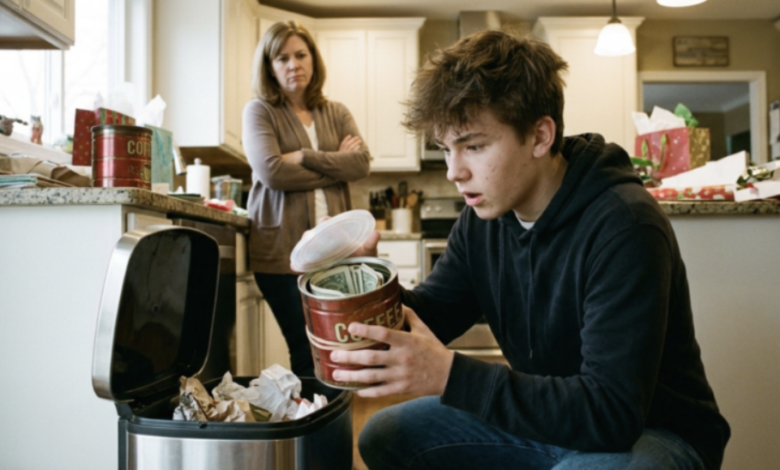
Before I could answer, she walked toward the trash can and dropped the gift inside.
For a moment, nobody moved.
Then my sixteen-year-old grandson, Tyler, entered the kitchen.
“Mom, what did you just throw away?”
“Nothing you need to worry about,” Vanessa replied.
Tyler looked into the trash can and pulled out the wrapped container.
“Grandma brought this for us!”
He removed the paper and discovered a small yellow envelope attached to the lid. His name was written across it in familiar handwriting.
He stared at the envelope.
“Grandpa wrote my name.”
The room became silent.
My husband had been gone for twelve years, but Tyler recognized his handwriting from old family photographs and greeting cards.
“Can I open it, Grandma?” he asked.
I nodded, struggling to keep my emotions under control.
Inside the envelope was a folded letter.
Tyler carefully opened it and began reading aloud.
“My dear Tyler, the world will often encourage you to measure everything by its price. You may meet people who believe expensive possessions make someone important. Remember that the greatest gifts are often the ones that cannot be purchased.
“When your father was young, your grandmother and I sometimes struggled to afford everything our family needed. Nevertheless, we made sure our home was filled with love. We wanted our son to understand that his worth would never depend on how much money we had.
“Never be ashamed of honest work, a modest home, or people who give what they can. If you must choose between impressing others and treating someone kindly, choose kindness.
“With all my love, Grandpa Walter.”
Tyler lowered the letter. His eyes were filled with tears.
Madison, his older sister, had come downstairs with the nine-year-old twins, Ethan and Emma. They gathered around him, curious about what had happened.
When Madison learned that Vanessa had thrown away Grandma’s present, her expression changed.
“You threw it away without even opening it?” she asked.
“Because it was a coffee can,” Vanessa replied impatiently.
“That doesn’t make sense,” Madison said. “You didn’t even know what was inside.”
Tyler looked directly at his mother.
“Grandma brought us something Grandpa wrote, and you treated it like garbage.”
Vanessa opened her mouth to respond, but no words came immediately.
Then Tyler reached into the can again and discovered a small velvet pouch. Inside was an old silver pocket watch that had belonged to Walter and, before him, Walter’s father.
Three words were engraved on its back: Work. Love. Remember.
“Grandma, why are you giving me this?” Tyler asked.
“Because your grandfather wanted you to have it when you were old enough to understand what it represented,” I explained.
Tyler held the watch carefully before wrapping his arms around me.
“I’m sorry, Grandma. I should have visited you more often.”
I gently stroked his hair.
“You have nothing to apologize for, sweetheart. What matters is that we have time together now.”
Madison opened her own can. Inside, she discovered a photograph of herself as a newborn, a small hospital bracelet, and a letter Walter had written for her.
Ethan found a wooden toy car he remembered playing with when he was little. Emma discovered a knitted rabbit whose loose ear I had repaired years earlier.
Each object brought back a memory.
Soon, the kitchen was filled with questions and laughter as the children discovered pieces of their family history. They wanted to know what their grandfather had been like, where he had worked, and why I had kept every little item.
For the first time in years, nobody asked how much a gift had cost.
They simply wanted to know the stories behind it.
Then Tyler discovered another envelope hidden at the bottom of his can.
“This one says it’s for Dad,” he announced.
Rob immediately looked up.
The letter had been written during Walter’s final months. I had kept it safe because my husband had asked me to give it to our son when he was ready to understand its message.
Rob sat down beside Tyler as the boy unfolded the paper.
“My son,” Tyler read, “I have loved you every day of your life. Your mother and I worked hard because we wanted you to have opportunities we never had. We hoped you would build a good life and give your children a loving home.
“But please remember that success is not permission to look down on people who have less.
“If your children ever begin to believe their grandmother is worth less because she cannot buy them expensive things, I hope you will have the courage to correct them.
“Do not let them learn cruelty from your silence.
“One day, you may have to choose between keeping everyone comfortable and standing up for what is right. Remember that silence can look like peace to the person who benefits from it. To the person being hurt, it can feel like abandonment.
“Look after your mother. She will tell you she is fine and insist she needs nothing. Do not mistake her dignity for a lack of need.
“And do not wait until she is gone to understand how much she gave you.
“With love, Dad.”
Tyler finished reading.
Rob covered his face with his hands. His shoulders trembled as he struggled to contain his emotions.
For years, he had missed opportunities to defend me because he feared arguments at home. He had convinced himself that remaining quiet was the easiest way to preserve peace.
Now, hearing his father’s words, he finally understood the cost of that silence.
“Mom, I’m sorry,” he whispered.
I looked at him.
“I love you, Rob. But I cannot spend the rest of my life trying to prove that I deserve kindness.”
He knelt beside my chair and took my hand.
“You deserved better from me. I should have spoken up.”
“An apology is a beginning,” I told him gently. “What matters is what you do next.”
I eventually left the house that afternoon, taking my handbag and the remaining gifts with me. I was disappointed, but I no longer felt that I had to accept every hurtful remark simply to remain part of the family.
The following morning, Rob arrived at my little house carrying his father’s old leather briefcase.
“Mom, I found Dad’s papers,” he said.
Inside were old financial statements, legal documents, and a folder marked with my name. Walter had apparently made arrangements intended to provide for my financial security after his death.
Some records were incomplete, and neither Rob nor I knew exactly what had happened to every account.
We contacted an attorney who reviewed the documents and arranged for the relevant financial records to be investigated.
The process took several weeks. Eventually, the review clarified which assets remained, which transfers had legitimate explanations, and which transactions required further examination. A portion of the funds was recovered through the appropriate process.
I did not suddenly become wealthy, but I gained something important: greater financial security and the ability to make decisions without constantly worrying about unexpected expenses.
More importantly, Rob began changing his behavior.
He visited regularly, repaired the loose step on my porch, and called simply to ask how I was doing. He started asking about my childhood, my marriage, and the paintings I had abandoned after Walter died.
One afternoon, he encouraged me to begin painting again.
“Mom, if you want to paint, then paint,” he said. “You don’t need permission.”
I laughed.
“I certainly don’t need permission from you!”
For the first time in a long while, we laughed together without tension between us.
Vanessa’s change took longer.
Initially, she remained defensive about what had happened. However, she gradually noticed that the children were visiting me more often and talking about their grandfather with genuine interest.
Tyler kept the pocket watch in a protective case. Madison treasured her grandfather’s letter. Ethan displayed his wooden car on his desk, and Emma slept with her repaired rabbit.
One afternoon, Vanessa arrived at my house carrying a homemade chocolate cake.
“Marion, could we talk?” she asked.
I invited her inside and poured two cups of tea.
She placed the cake on the table and looked down at her hands.
“I owe you an apology,” she said. “What I did on your birthday was unkind. I judged your gifts before understanding what they meant, and I made you feel unwelcome.”
I listened quietly.
She explained that she had grown up believing that expensive possessions were proof of success. Over time, she had allowed those beliefs to influence how she treated other people.
“When I saw the children opening the cans, I realized they were happier than I had seen them in months,” she admitted. “They weren’t asking about prices. They wanted to hear about their grandfather.”
Her eyes filled with tears.
“I am truly sorry.”
I appreciated her apology, but I also knew that trust could not be restored through a single conversation.
“I am willing to move forward,” I told her. “But I need you to understand that respect must be part of our relationship. I don’t want my value measured by what I can buy for anyone.”
Vanessa nodded.
“I understand.”
We shared the cake and talked about Walter. For the first time, she asked questions about the man he had been, rather than focusing on what he had left behind.
Our relationship did not become perfect overnight, but we began rebuilding it one conversation at a time.
The following year, I celebrated my eighty-first birthday at my little house.
I asked for no expensive presents or elaborate arrangements. I wanted only a family dinner with the people I loved.
Tyler arrived with a framed photograph of the two of us. Madison brought a handmade card. Ethan had repaired his wooden car with Rob’s help, and Emma presented me with a small blue scarf she had knitted.
Rob and Vanessa brought the food and helped prepare the table.
Nobody complained about the size of my house or the simplicity of the celebration.
We ate together, shared memories, and laughed about the little things Walter used to do.
After dinner, Tyler stood and took the pocket watch from his jacket.
“Grandpa left us something important,” he said. “He taught us that love isn’t measured by the price of a present. Grandma showed us that memories can be more valuable than things we buy.”
He turned toward me.
“I hope we never forget that.”
I looked around the table at my children and grandchildren. For years, I had feared that growing older meant becoming less important to the people I loved. I had worried that my modest income and quiet lifestyle would eventually leave me on the outside of their lives.
But that evening reminded me that genuine family relationships are not built on expensive gifts or impressive appearances.
They are built through time, understanding, honesty, and the willingness to treat one another with dignity.
Walter had been gone for thirteen years, yet his words continued to guide our family. His old pocket watch, the handwritten letters, and the simple keepsakes had accomplished something no expensive present could have achieved.
They had reminded us of who we were and what we wanted to become.
As the evening ended, Emma climbed into my lap and asked whether I would tell her another story about Grandpa.
I smiled and reached for one of the old photographs.
“Of course, sweetheart,” I replied. “There are still plenty of stories left to tell.”
And as my grandchildren gathered around me, I understood that the greatest inheritance I could give them was not money, jewelry, or anything they could place on a shelf.
It was the knowledge that they belonged to a family whose love was worth far more than anything money could buy.